Friday, October 06, 2006

A glimpse at what you can admire these days in Paris: From the fairy by Gustave Moreau to Tinker Bell by David Hall and the Blue Fairy by Gustaf Tenggren.


More next week...

From the Serbian magazine Mikijevo Carstvo number 6 published on March 12, 1939.


Of interest today: Amazon.com has added the Art of Ratatouille by Karen Paik to its list of upcoming books and Steve Hulett has posted part 5 of his 1978 interview with Ward Kimball.

Thursday, October 05, 2006


A fun new book by Disney Editions having just been released last week containing quite a lot of rare Disney artwork, I have asked its author, Jeff Kurtti (well known to most of you) if he would accept to write a short "making of" article for this blog. He was kind enough to do so.

[Didier,

Disney Dossiers: Files of Character from The Walt Disney Studios is a collaboration between Disney Editions and becker&mayer! (they're the publishers of Disney archivist Robert Tieman's Disney Treasures and Disney Keepsakes books.) They brought me in for my Disney knowledge and off-kilter world view. ;-)

The idea was straightforward, but the solution was complex.

There was a desire to put out a volume that dealt with the wide-ranging stable of Disney characters, but in a way that was not as structured and scholarly as John Grant's classic Encyclopedia (which has already seen three editions), that had some humor in content, and the always-clever b&m! design approach.

Although for obsessive folks like us it seems second nature, there are a lot of dyed-in-the-wool Disney fans (and new generations coming up) who don't know as much about the canon and characters as they want to, and to whom a consolidated entree to this information is a little daunting.

Our idea was to create an informative and intelligent book, but one that is accessible, unintimidating, and fun. A primer on the characters for the uninitiated, a new take on them for the fan, and most of all something that celebrates the characters and their stories in a way that invites the reader to explore, and has a tone that is both irreverent and respectful.

Easy, non? ;-)

In approaching the illustration, we had access to the wonderful database of images from Disney Publishing's decades-long history, which have been organized under the loving care of Ken Shue, vice president and global creative director of Disney Global Books. There is wonderful stuff in there from Golden Books, Whitman books, and the like, dating back to the 1940s, maybe even before. (The key front art of the Pinocchio Golden Book that I grew up with is on the lower left of the Dossiers cover).

In addition, we called on fellow Disney writer/historian and longtime pal Jim Fanning to bring his unique eye for unusual and rare art work to the project. He was our man in the Walt Disney Feature Animation Research Library and the Walt Disney Photo Library, and his instruction was to avoid the cel set-ups and publicity images that are always floating on top for the easy grab, and to find the less-seen (and frankly oddball) art, as well as character poses and uses that are less-seen.

Lella Smith and Fox Carney in the Walt Disney Feature Animation Research Library did the heavy lifting in actually getting us the data files. Ed Squair and his staff at the Walt Disney Photo Library did their typical detective work in turning over rocks and opening dusty files to find us cool images.

We organized the material in an intentionally non-chronological fashion, more by types and sub-types. Our thought was that the fans already know the chronology, and the casual reader doesn't know--and quite probably would be puzzled by a rigid chronology.

The concept we hit on was simply to (as we should) treat the characters as real personalities, and (as the Archives has with real humans), present a simple file folder full of assorted materials. That way we could present a variety of complexity of information, but in digest form, often as "notes" that are "clipped" to the files, asides, and brief data.

The overall conceit of the material, then, is that you are in receipt of a set of dossier files on a broad assortment of Disney's great animated stars (we even got Dave Smith in on the joke--the introduction is a "letter" from Dave, explaining to the reader--or "researcher," in this case--what these files are for).

Finally, in the hands of Senior Editor Jody Revenson and Editorial Assistant Jessica Ward at Disney Editions and the becker&mayer! editor (Amy Wideman) and designer (Megan Noller Holt) all of these ideas and material were brought together in a rich presentation that I'm sure even the most scrupulous Disney fan will find refreshing, entertaining, and really out-of-the-ordinary.

I am really proud of the finished product, and hope that die-hards and newbies alike enjoy the book as much as we enjoyed making it--and as much as I still enjoy leafing through it time and again!

Jeff]

Don't miss today: The second part of Steve Hulett's interview with Wilfred Jackson and Wade Sampson's article Emily Bevar Spills the Beans.

Tuesday, October 03, 2006


From the Serbian magazine Mikijevo Carstvo number 3 published during the year 1939.


Steve Hulett has posted the 4th part of his 1978 interview with Kimball. Definitely worth reading. It deals with Norm Ferguson.

Monday, October 02, 2006


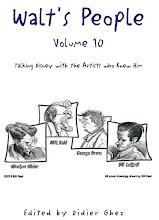
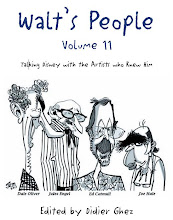
Unfortunately Walt's People - Volume 4 will be late by at least one month. I never release any volume before the "founding fathers" of the project send me their detailed revisions, and one of the most important members of the group (as far as revisions are concerned) is hard at work on various book projects and was understandably unable to give me his feedback on time. I take the news very positively as Volume 4 should not be delayed later than December or January apparently, but even more so because the reason it is late is one of the best that could be: we will soon see a few more in-depth, well-researched works about fascinating aspects of Disney history.

To reward your patience, here is my introduction to this upcoming volume.

I like to write Walt’s People introductions while traveling, be it on business or on vacations. This time I am on vacation, on the small Greek island of Amorgos. What makes this a special occasion, though, is the fact that this trip marks an important break in my life: After having worked for 10 years for The Walt Disney Company, I have decided to move to Warner Bros. No worries, though. I will carry on working on Walt’s People during my free time; this project was never linked to my professional life. It was and remains a “labor of love.”
The move to Warner, however, becomes meaningful when it makes me seriously think about launching a new book series, in parallel to Walt’s People: Bugs’ Buddies (my thanks to Steve Schneider for suggesting this title), which would focus on Warner animation artists. Will I find an editor for this project as passionate about Warner animation as I am about Disney? Or will I end up launching this project myself someday? We will see.
What is certain is that this project is also long overdue and would serve as a crucial complement to Walt’s People. We already saw in past volumes that understanding the creative life of Disney artists like Grim Natwick, Friz Freleng or Frank Tashlin is close to impossible without taking into account their experiences at other studios. In addition, the links between Warner’s animation history and Disney are many and are often fascinating: From the creation of what would become the Warner animation studio by Walt’s pre-Mickey Mouse artists, Rudy Ising and Hugh Harman, to the brief stint of Chuck Jones at Disney in 1953, and through the various references to Disney within Warner cartoons, like the caricature of Ward Kimball in Hiawatha’s Rabbit Hunt (1941).
Once again, time will tell if I manage to find an enthusiast editor for Bugs’ Buddies. Regardless of what happens, however, the momentum is there, as more and more serious animation historians have recently caught a surprising new wind. Something extremely exciting is going on. CartoonBrew’s editor Jerry Beck summed it up: “There is a quiet revolution happening in the animation community, and it's all thanks to the Internet. With the explosion of blogs in the past year, a wide range of difficult-to-find historical material is becoming publicly available for the first time. The availability of this material, which includes artwork, documents, films, and analysis, doesn't only benefit historians; it also benefits artists in all parts of the world, who now have open access to examples of quality animation.” A few years ago Michael Barrier, the godfather of animation history and my main influence when starting Walt’s People, launched his blog; just over a year ago Clay Kaytis started Animation Podcast, a site solely dedicated to great interviews with animation artists; a few months ago, Animation Blast’s editor, Amid Amidi, created Cartoon Modern, a blog that complements his book of the same title and offers extremely in-depth insights into the lives of many key animation artists, quite a few of whom worked for Disney.
And then things went wild! Animator Jenny Lerew posted more amazing Freddy Moore artwork (from the collection of James Walker) than I had seen in years (and that screams to be collected in book form), along with rare “animator drafts” that give an idea of which animator worked on which scene within Disney shorts and features. Danish director Hans Perk, from A. Film,[released many more of those “animator drafts,” and animation historian Mark Mayerson used them to analyze the shorts and features in an unprecedented way and shed fascinating new light on the work of many of Walt’s people. In other words, the more information released, the more people decide to release new information, leading to fresh understanding and knowledge. Of course, this also allowed us to identify new sources of unpublished interviews with Disney artists that will soon appear in Walt’s People: Freddy Moore’s assistant Ken O’Brien by Jenny Lerew, Art Stevens by Pete Docter…
The “quiet revolution” that we see happening on the web brings me to a similar process experienced by Walt’s People. Many key Disney historians have recently given me the authorization to publish their work, as they see this as a way to protect material that was at risk of being lost or irrevocably damaged—some interviews were even preserved in reel-to-reel format! In this volume, Charles Solomon, author of one of my favorite books on Disney animation, The Disney that Never Was, is one of the new key historians joining the Walt’s People team.
Another new participant is Joe Adamson. His oral history with Dick Huemer is the keystone of this volume. I had admired this interview for years after having read excerpts of it in Funnyworld and had always dreamed of releasing a Disney-related uncut version in Walt’s People.
Of course, focusing on Huemer’s career would not have been complete without tackling in-depth the career of his creative alter-ego Joe Grant. Who better than Michael Barrier to draw interesting and surprising answers from such a notoriously tough interviewee? The Huemer focus also allows us to welcome the third of Walt’s People’s new contributors, Brian Sibley, who appears in this volume as both interviewer and interviewee.
There are many more exciting features in this volume, including a surprising new look at the career of Peter Ellenshaw; the seminal interview with Roy Williams by Don Peri (another important new member of the Walt’s People team), who shows us who the Big Mouseketeer really was; another foray into the world of Disney comics with Dick Moores and Roger Armstrong, thanks to comics expert Alberto Becattini; the second part of Celbi Pegoraro’s interview with Floyd Norman; an interview with Eric Goldberg; and a look at the abandoned project Mary Poppins Comes Back.
My own favorite from a historical point of view, however, is Dave Smith’s chat with Lou Debney, as it gives us a first glimpse at the Disney Studio during WWII, a subject that we will explore in much more detail in Walt’s People - Volume 5.

Not enough scope yet for one single volume? So before surrounding ourselves, once again, with Walt’s people, let’s meet Walt’s first star…

Didier Ghez
Amorgos, June 2006


An unusual series of 6 posters from the 1951 Disney project How to Catch a Cold created for Kleenex is currently being sold on ebay.

I was wondering if any of the readers of this blog knew whether any of the characters on the poster are actually caricatures of Disney artists.


I bought last week on the internet this very astonishing book from Mexico, published in 1944 by Ediciones Modernas.

What makes it weird, of course is the fact that, as far as I know, no Almendrita (The Small Almond) project was ever produced by Disney and that the book appeared however under the Disney label in a series that is clearly authorized by the company.

One more mystery added to the list.


One day late (on my side), this just in from Dennis Books:

["HAPPY BIRTHDAY TO MICKEY MOUSE ON HIS BIRTHDATE OCT. 1st "

Perhaps this date will cause controversy ? I have Disney Studio records showing that throughout the years Mickey's birthdate has been celebrated on various days in September and October. HOWEVER I recently found a letter written by Walt Disney in which he stated "He was born on Oct. 1, 1928. That was the date on which his first picture was started so we have allowed him to claim this day as his birthday". I guess I will have to go along with Mickey's father.]

Of course, today Mickey's official birth day is recognized by The Walt Disney Company as November 18, the day of Mickey's screen debut.


A lot of excellent reading this morning. Steve Hulett has posted two more of the interviews he conducted in 1978. One with Ward Kimball (part 1, 2 and 3) and one with Wilfred Jackson. I am happy to say that Walt's People played a small part in getting those interviews back to the surface.

Toons at War has a whole series of great new posts, including one about Hank Porter that I particularly loved to read.

The site of the Walt Disney Family Foundation was recently updated and contains great new material including an interview with James Algar and one about Walt appearance in front of the House Committee on Un-American Activities (HUAC). Not one of Walt's most inspired moments.

A Films published two nice images from Walt's commercial ventures (image 1 and 2 can be found here).

Amid Amidi created Tom Oreb's MySpace page.

Finally, I should mention that the Disney Books Network was recently updated.

Tuesday, September 26, 2006


Are Myklebust sent me last week this link to an excellent article about the Mickey Mouse gaz mask. Since the Mickey Mouse gaz mask was very heavily used during the London blitz, and since I am going to London this evening, the timing sounded right to post this.

My trip to London means that the blog might be quiet once again this week.

Monday, September 25, 2006

I was working on my interview with Dave Michener (transcribed by James D. Marks) this weekend and caught the following anecdote that I thought you might enjoy:

"[Disney artist] Jack [Fergus] belonged to a club called the “Tip-Top Club,” which was anybody over 6 foot 6 inches. I can tell you a funny story about Jack because we were assistants together at that point in my career. We were walking down the main hall in the animation building one day coming back from lunch. He had such an incredible arm span he was dragging his finger tips on both sides of the wall as we came back in the building. Walt Disney had just gotten out of the elevator and was coming our way. He looked and saw Jack and he said, “ Jesus Christ!” Jack was a very, very big man. "


I stumbled this morning on a large series of pre-war Swiss Mickey Maus magazines sold on ebay by "comik-collector." I mention them here as they are extremely rare and it is the first time I see such a large series being sold.

For more information about this magazine and other Disney magazines published all accross the world before WWII (including the Serbian ones I keep showing on this blog), check my article on the subject here.


Three excellent read this morning: An interview with Ken Anderson and one with Claude Coats (part 1 and 2) by Steve Hulett on The Animation Guild Blog, as well as an excellent article about Animator training through the decades by Tom Sito on the Animation World Network. Enjoy!

Friday, September 22, 2006


As a side note, the special issue of Telerama mentioned below includes this homage of Sylvain Chomet, director of Les Triplettes de Belleville, to 101 Dalmatians.


The other man without whom the exhibition would not exist is of course Robin Allan, author of the book Walt Disney and Europe, which served as the foundation for the concept of the exhibition.

Robin (left) is doing much better (he had a stroke last year) and is seen here discussing with my great friend and fellow Disney enthusiast Sebastien Durand.

Quite a few other personalities attended the inauguration ceremony, among them Bob Iger, Charles Solomon, Andreas Deja,...

One of the attendants was a Disney artist, old time friend and collector of Disney original art who acquired a few months ago a couple of drawings of the Cuban Caballero that we showed a few weeks ago on this blog thanks to Jenny Lerew. The main reason I mention this fact is that I learned at the event that we might soon see those drawings in a book about Freddy Moore, which might be the first of a long series of art books about Disney artists. I can't add details at this stage, but let's just say that the project seems very serious and involve quite a few very (I mean very) knowledgeable animation experts.


Two men are responsible for the phenomenal quality of the Il Etait une Fois Disney exhibition. The first one is Bruno Birveau, the curator of the event.

You can see him, on the right of this photo, discussing with Michel Mandry, former editor-in-chief of Le Journal de Mickey and living memory of Disney in France.


I remain pretty swamped at work and things are not getting better (don't worry, I love it), which explains my weird silence of the last few days. I also still have not received the photos I need to cover properly the Il Etait une Fois Walt Disney exhibition at the Grand Palais, but I have decided to start tackling the subject, mentioning various odds and ends before staring it in the eyes, hopefully next week. If you really can't wait, speak French and want to start somewhere, check the Disneyland Resort Paris fan site. They are theme park enthusiasts, so their focus is slightly weird, considering that the exhibition is mostly about animation, but it will sort of give you a feel of the place and of the size of the event.

So what is it all about? There are a few events that count as the most important in my life as a Disney enthusiast. One is the first interview I conducted with Disney artists (the Brizzi brothers at the Disney Studio in Montreuil), then there is the inauguration of Disneyland Paris in 1992. But above and beyond all this stands the inauguration of last week.

Let me try and explain why even while typing this I start getting goosebumps. Picture first the fact that this exhibition is taking place at Le Grand Palais, which along with Le Louvre and Le Musee d'Orsay is one of the most prestigious museums in Paris. It's the equivalent of the National Gallery in London or L'Hermitage in St. Petersburg. That's a good start but is far from enough.

A lot could still go wrong at this stage. The works displayed could have been badly chosen: say that the curator decides to focus only on cels and backgrounds, final shots from Disney movies, Disneyana material, the life of Walt Disney. None of this would make sense in the context of Le Grand Palais. The exhibition could be too broad, covering the current works of the Studio and therefore venture into the commercial realm of Disney. Still a mismatch. All those pitfalls were avoided by the curator of the exhibition. Pretty amazing feat for an outsider! He selected only beautiful mostly never-seen-before artwork - especially concept art - and made sure the only movies featured were those that Walt had personally supervised.

But once again at this stage the exhibition would only be extremely good, not yet great. It would be what we have seen before a few times: a beautiful homage to the art of Disney (like what is currently happening in Japan), which would satisfy Disney enthusiasts and cater to animation fans. What brings the whole thing to another level is the very concept of the exhibition: it is a quest to understand what works of art (especially European ones) inspired the art of Disney artists. Based on the seminal book of Dr. Robin Allan, Walt Disney and Europe, the Grand Palais exhibition displays works by the greatest European masters, like Gustave Dore, Heinrich Kley, or even Breughel, German expressionists and French architect Viollet le Duc alongside Disney concept art, layouts and backgrounds. And as all of you know, Disney's artists works do not pale in front of those of those masters. In fact the association is mind-boggling: if you are a layman, the quality of the concept artists' works become even more obvious and you start understanding that Walt had some really outstanding individuals working for him, that he was not the only one who drew everything and that the Studio was far from being a factory. If you are a Disney enthusiast you are bound to be stunned by connections with famous or less famous works of art from the past that you were not aware of.

Of course for Disney enthusiasts, the walls covered with Mary Blair and David Hall drawings (to name a few) help you reach animation heaven, as do the fact that most of the books that Walt collected during his 1935 trip to Europe are displayed.

And then weird things start happening: The French intellectual magazine Telerama (above) releases a special issue above Disney, and while one can feel that its journalists hate to love Disney, this simple event in itself is a sign that something strange is going on. Picture The New Yorker releasing a special issue about Disney and you will understand what a Frenchman can feel when he sees this. Or when the TV channel Arte dedicates a special evening to Disney and features Disney's Alice in Wonderland. In other words, there is definitely something bizarre going on in France at the moment and even though some in the traditional media like Liberation or Le Monde hated the exhibition, it is still obvious that for an honnest visitor (one not blinded by ideology) this exhibition should be a revelation about how much outstanding art was actually created by the Disney Studio, how little has been seen to date and how intimately linked it is to European cultural heritage.

I am convinced that a few persons will become Disney historians or at least serious enthusiasts after having walked out of Le Grand Palais. Our thanks go to an exeptional man for having achieved this feat: the curator of the exhibition, Bruno Girveau. It takes guts in France, in the artistic community to undertake and achieve such a project!

Wednesday, September 20, 2006


Are Myklebust sent me a few weeks back this link to Larry King's interview with Art Linkletter, the first part of which is definitely worth reading as it deals with Art's memories of Walt.


All the people I've met in Paris who had already read Tom Sito's newly released book Drawing the Line: The Untold Story of the Animation Unions from Bosko to Bart Simpson had found it to be not only fascinating but also a page-turner. This one is defintely a "must-have" (as if anyone kept a doubt about this).

[Thanks to Carla Fallberg for Tom Sito's photo.]


As for me, I found of particular interest some posts about animation and Disney artists:

The obituary of artist Bernard Wolf by Mark Kausler; an old post by Hans Bacher on his blog called A Tribute, that features quite a few photos of former Disney artists including Walt Stanchfield (left) - whom I had mentioned on this blog and whose interview will appear in a future issue of Walt's People, but whom I had never seen before; a more recent post by Hans called "some more history" that features photos of Eric Larson and of the Beauty and the Beast crew during a research trip in Paris; and two posts from the Animation Guild Blog: one about The Norconian party that followed the completion of Snow White and the Seven Dwarfs and one about Ken Anderson.

Enough to keep one busy for a while, I would say.

Tuesday, September 19, 2006


Disney comic book enthusiasts should enjoy this post by Mark Kennedy on Temple of the Seven Golden Camels about the Carson Van Osten handouts, as well as this web page that shows quite a few scans of covers and interior material from the Serbian Mika Mis magazine.


Then there is a beautiful new series of posts on Toons at War by David Lesjak.


Apologies for this long silence. I am still swamped with work and catching up due to my trips to Paris and Italy (earlier on). I will post a report about the exhibition this week. It was a stunning event launching an exhibition that is without a doubt the best Disney exhibition ever (I do not believe I am exagerating here). I was so taken by it, unfortunately, that I forgot to take pictures, which is the explaination for the delay in posting the report this week. The report, hopefully will be illustrated.

My posts today, will therefore try to catch up with what I should have posted last week, being mainly recommendations about great pieces to read. Some obvious, some less more so.

I would start with the second and third installements of Floyd Norman's series about The Jungle Book on JimHillMedia, as well as with an article about the actors that could have played Eddie Valiant by Jim Hill.

Monday, September 11, 2006


Apologies but that's it for this week. I will be traveling to Paris tomorrow for work and to attend the inauguration of the Disney exhibition at the Grand Palais and will unfortunately not have time to take care of the blog.

More next week with a full report about the exhibition.


Of course the most talked-about book of the moment is the exhibition catalog from the Museum of Contemporary Art in Tokyo, The Art of Disney. See the PBCB blog, the Temple of the Seven Golden Camels blog and CartoonBrew for more details.

How to get one's hands on it is the big challenge of the week!


I discovered this book while browsing on Amazon yesterday. Should be a very nice read for next year.

For more info about who Charles Ridgway is, check this past article from Wade Sampson.

Thursday, September 07, 2006


Just in from Dennis Books to follow-up on last week series about Walt and polo by Jim Korkis:

From Radio Stars magazine (January 34). "He rode to glory on a mouse."


Do not for any reason miss Michael Barrier's post from September 6, 2006 on his site. You are certain to love it.

To answer your question Mike: please do post more of the documents you may have. Who cares if they interest only a small audience? That's the audience that will use it to further Disney research in new, fascinating ways.

Speaking of Mike, his upcoming book, The Animated Man: A Life of Walt Disney, is now listed on Amazon.com


And here is Jim Korkis' last article of the week!

VOICES SINGING THE SONGS OF THE SOUTH

Currently I am working on an extensive article on Disney's SONG OF THE SOUTH for the magazine, Hogan's Alley, and here is a research vignette on some of the uncredited vocal work in that film:

Much of the uncredited singing was done by the Hall Johnson Choir, an African American choir led by Hall Johnson (a highly regarded African American choral director, composer, arranger and multi-instrumentalist) that performed to enthusiastic audiences in various prestigious New York venues. National recognition came when Johnson's choir performed under his direction in Marc Connelly's Broadway production of "Green Pastures" in 1930.

Five years later, Johnson took the choir to Hollywood, California to participate in the film version of "Green Pastures"(1936). Johnson and the choir remained in the Hollywood area and appeared in other films including "Hearts Divided" (1936), "Banjo On My Knee" (1936), "Lost Horizon" (1937), "Tales of Manhattan" (1942) and "Cabin In the Sky" (1943). Their performances also included the crows in Disney's "Dumbo" (1941) and "Song of the South" (1946). Johnson returned to New York in 1946 where he organized the Festival Negro Choir of New York. He was posthumously honored for his work in films by being elected to the Black Filmmakers Hall of Fame in 1975, five years after his death.

The DeCastro Sisters were a female singing group: they consisted of Peggy, Cherie, and Babette DeCastro. In 1945, the DeCastro family moved to the United States from Cuba and the sisters became protégées of Carmen Miranda. They had a style similar to the popular Andrews Sisters trio but with a Latin flavor. It was probably their connection with Miranda who had worked with Disney on "The Three Caballeros" that helped get them their first film work doing some singing background vocals for "Zip A Dee Do Dah" in "Song of the South".

Wednesday, September 06, 2006


I was working this weekend on a marvelous interview of Frank Thomas by Christopher Finch and Linda Rosenkrantz for a future issue of Walt's People and particularly liked the following story about Tytla:

"I had a scene in Pinocchio. Bill Tytla was doing Stromboli, and in this scene Stromboli reached across the table and chucked Pinocchio under the chin. He was sitting on a little piece or bologna or something and fell over backwards. For some reason, some production problem, I had to do Pinocchio first, which was silly, because it was Stomboli's doing this that really motivated the action.

So I went down to Bill and I said, “How are you going to animate this?” Bill was pure emotion, wonderful guy, and his eyes would light up, he would tell me what Stromboli was like, what a big guy he was and how he'd move. He starts coming at me like this and backing me up across the room. I backed into the scene cabinet, half tipped the thing over and all the scenes start spilling out all over and Bill never stops.

So I go back and tell Milt, who was in the room next to me and Milt thinks this is the funniest thing he's ever heard, so he goes running into the room across the hall and told the story about when Frank went to see Bill Tytla and he gets to me backing into the cabinet and he starts waving his arms like this and he hits the lamp which was hanging down here and he knocked it down and it came crashing. He goes into the next room to tell them about it and he knocks into a storyboard and he knocks it off: it's hanging and it falls to the ground. Well when things fall, it fell flat like this, all the pushpins shoot straight out and then all the sketches… there's a slight pause and all the sketches just fall right down. Do you know how long it takes to get a storyboard just right and to have it all gone?

And Milt went to the next room, but by then word had gotten there and they said, “DON'T TELL THAT STORY!”


From the Serbian magazine Mikijevo Carstvo number 2 published during the year 1939.
I just received this email from Robert Tieman about his upcoming book Mickey Mouse Treasures that I mentioned on the blog a few weeks ago:

"I see that someone on your blog asked when my new book would be available. You correctly noted in the first blog entry that it would be park-exclusive in February or March 2007. But I think there has been a misunderstanding about when the book would be available on Amazon: it is September or October of 2007. Not this month in 2006.

I'm sorry to disappoint eager readers who thought they could buy the book this month. Alas.

Robert. "

Here is the fourth of Jim Korkis' short stories.

BILL EVANS AND DISNEY TOPIARY

For Volume 5 of WALT'S PEOPLE, I am currently transcribing my interview with the legendary Bill Evans who landscaped Walt's backyard and later Disneyland and Walt Disney World. Here is an early excerpt as well as a reminder to pick up the three volumes of WALT'S PEOPLE currently in print. Walt had been enthralled by the topiaries he had seen on his European trips and wanted something similar for Disneyland.

"There are a number of differences between our topiaries and the ones of legend that go back about 3,000 years. It's an ancient art. It takes about fifteen years to get it into a recognizable shape. That wouldn't do for Walt. He asked us if we could speed up the process a little bit. We told him we thought we might be able to give him something that was acceptable in a couple of years. The early ones were all Disney inspired like the hippos from FANTASIA," said Evans.

The first results appeared in Fantasyland in 1963 but the figures were later moved to their permanent location in the front of "It's A Small World" in 1966. The first animals included the hippos from FANTASIA but also Dumbo and was the start of a tradition at Disney theme parks worldwide.

A wire frame is created and originally there were trees (like an olive tree) and shrubs grown inside the frame although that could take three to ten years. Today, temporary topiaries can be created almost overnight by using a frame and sphagnum moss with vining plants. However this temporary version will not last as long as the shrubs grown inside the frame.

There are over 120 shrub and 65 sphagnum character topiary throughout the WALT DISNEY WORLD Resort as well as hundreds of geometric and free-form topiary shrubs and trees. Pete's dragon, ELLIOT, is the largest shrub character topiary. Grown and trained for 10 years, this Podocarpus macrophyllus measures over 10 feet tall and 14 feet from head to tail.


I just ordered this DVD which looks like a "must-have".

Tuesday, September 05, 2006

I have good news. It looks as if I have now located a copy of the movie Cri-Cri el Grillito Cantor (see my very first post on this blog). I should receive a copy of it within the next few weeks and will post the Three Little Pigs special cartoon it contains on YouTube after I do.

Please note that I will be doing all this purely for historical reasons.

Are Myklebust also noted that unlike previously mentioned the movie was not directed by Carlos Amador but by Tito Davison.

Third part of this week series of articles by Jim Korkis.

NAKED DISNEY

Researching some articles is more interesting than others.

The Playboy "Playmate of the Year" for 2006 happens to be Kara Monaco. Born in February 1983 in Lakeland, Florida and graduated from Lake Brantley High School in 2001, this five foot six inch blonde-haired, blue-eyed young lady began her performing career as a Disney princess at Walt Disney World. She performed as seven different characters for parades and "meet and greets" including Snow White, Cinderella, Ariel the Little Mermaid, and Alice in Wonderland. "I most liked being Cinderella," she said in a recent interview, "All the little girls love Cinderella". In fact, this issue of "Playboy" has photos of Kara as "Snow White" and "Cinderella". She started appearing in "Playboy" special editions August 2004 and was a centerfold in the June 2005 issue which generated many articles entitled "From Cinderella to Centerfold". So if you are a Disney completist, these issues might be something you want to add to your collection.

This is not the first time a twenty-three year old female Disney performer has appeared in "Playboy". Dayle Haddon's first film role was in Disney's live action film "World's Greatest Athlete" (1973) and Disney was grooming her to become a leading ingénue. However, Miss Haddon had other career goals and appeared in the buff in the April 1973 issue of "Playboy", effectively ending her Disney career.

And let's not forget original Mouseketeer Doreen Tracy (left) who revealed all in the August 1979 issue of "Gallery" although to make things worse, in some shots she is wearing her mouse ears and Mouseketeer sweater.

That must be the power of Disney. Nobody ever mentioned when actress Debra Winger appeared nude that she began her performing career at the age of seventeen as a costumed character at Six Flags Magic Mountain in Southern California. She wore a furry troll costume (the mascot of the park at the time) and while changing on the back of a truck, it suddenly jerked, sending her head first to the ground. She was in a coma for three days and one doctor thought she would be completely blind for the rest of her life. Just one of the dangers of being a costumed character but probably not as dangerous as publicizing that you used to be a Disney Princess.

Great news! Clay Kaytis has posted the second part of his interview with Burny Mattinson on the Animation Podcast. No better way to start your day.

Also check this morning Floyd Norman's excellent article about The Jungle Book on Jim Hill Media and the post Still More Disney Reminiscences on The Animation Guild blog.

Monday, September 04, 2006


Here is Jim Korkis' second article of the week.

There has been a lot of discussion lately about the changing relationship between McDonald's and Disney so researching an article on the two companies, I thought I would take a look at the very beginning when Ray Kroc who led McDonalds to world prominence first met a very young Walt Disney.

In Ray Kroc's autobiography (GRINDING IT OUT, Contemporary Books 1977) is the following paragraph:

"My parents objected strenuously, but I finally talked them into letting me join up as a Red Cross ambulance driver. I had to lie about my age, of course. In my company, which assembled in Connecticut for training, was another fellow who had lied about his age to get in. He was regarded as a strange duck, because whenever we had time off and went out on the town to chase girls, he stayed in camp drawing pictures. His name was Walt Disney."

However that is not the end of the story. Years later in 1954, Kroc wrote to Disney:

"Dear Walt, I feel somewhat presumptuous addressing you in this way yet I feel sure you would not want me to address you any other way. My name is Ray A. Kroc...I look over the Company A picture we had taken at Sound Beach, Conn. many times and recall a lot of pleasant memories... I have very recently taken over the national franchise of the McDonald's system. I would like to inquire if there may be an opportunity for a McDonald's in your Disneyland development."

Walt responded with a warm letter informing Kroc that his request had been sent to the Vice President in charge of Disneyland concessions because Walt confined his activities to the creative side. So there could have been a McDonald's when Disneyland opened if that Vice President had followed up on the offer.


One great this about Holly's site (see below) is that it allowed me to discover that the Duckomenta has a website. For those of you unfamiliar with this project that rewrites the history of art as if the Disney ducks had been the inhabitants of Earth since day one this site might prove fun to explore. It's in German, but just click on the "Raum 1, Raum 2,..." links at the bottom of the page to explore the different rooms.


Those of you who have been checking The Disney Books Network those last few years know that I am not a big fan of theoretical books about Disney. This has not changed, which is why I can unfortunately not be enthusiastic about Holly Crawford's book Attached to the Mouse: Disney and Contemporary Art. This is a purely subjective point of view, the basis of it being: if you make some efforts reseraching a subject about Disney, why not make it real research about Disney history? That being said, my main criticism about Holly's book was its lack of illustrations (probably due to costs and copyrights reasons). A book about art inspired by Disney that did not show Disney-inspired art seemed pointless. I am glad to say that Holly now has a site that complements her book and that contains quite a few cool links to interesting art pieces, including the one you can see on the left by Alexander Kosolapov. This at least I find fun and interesting to a certain extent.


Just found one more in that series of French posters from the '30s that I started showing last week and could not help sharing it.


The Gremlins book reprint by Dark Horse is finally out. Interesting interview on the Dark Horse website with the people who piloted the project.

While Didier enjoys his time in Italy, Disney Historian Jim Korkis has agreed to share some "research vignettes" from articles he is working on. These research vignettes are short, fun facts Jim has discovered as he digs deep into Disney history to find accurate information for his forthcoming articles.

Here's a fun little item I ran across while I was researching the early days at the Disney Studios. The great thing about Disney history is that there is always something new to discover.

In 1934, there were 187 people working at the Disney Studios. When Walt wanted to gear up for production for SNOW WHITE that year, he needed more artists and he told his head of training, Don Graham, "I need 300 more artists! Find them!" So by 1935, there was a continual influx of new animators, assistants, inbetweeners, etc. flooding the Studio.

While things were exciting, they were also frustrating as the new artists were integrated into the studio or let go when they didn't make the grade. Above several of the desks was a mimeographed copy of what was called "The Animator's Prayer". One artist saved a tattered copy of that unique piece of Disneyana and I am reprinting it here for your amusement and edification:

THE ANIMATOR'S PRAYER

Our director, who art above us,
Blankity,Blank,Blank be thy name!!!
Thy pictures come, they will be done,
In color as in black and white.
Give us this day our daily razz...
And forgive us our animation
As we forgive those stories that are
Written for us.
Lead us not into chase, but deliver us
....from the Layout Artist!

Obviously, for those who are familiar with the animation process, this prayer is more amusing but for everyone it is an indication of the level of fun that existed at the studio even with the problems of a new project looming ahead.

Quite a few new posts these last few days on Toons at War. Also worth checking is Temple of the Seven Camels: in the post titled Another Tribute you will find beautiful documents related to Bill Peet and if you scroll down in the D&D6: Proportion post you will enjoy a fabulous concept drawing of The Jungle Book by my favorite concept artist, Ken Anderson.

Friday, September 01, 2006


Fascinating post on ASIFA Animation Archive's blog this afternoon. Not to be missed.
This story is becoming fascinating thanks to a post by Joakim Gunnarsson "There was an illustrated Chicken Little storybook probably done in the mid 70's (?) illustrated by Tony Strobl. (Released in Scandinavia as a part of "Kalle Ankas bokklubb".) It featured Donald, Goofy and several other regulars. If my memory serves me right the design on the drawing you have reminds me of Strobl's artwork in that book. But it was a looong time ago I last saw that book. Could it be that the project that Ken worked on got shelved and the script etc. ended up in the department wich handled the story books and they used it as a basis for one of their books?"

And I answer: Yes, that's clearly possible. It would be a similar situation to The Gremlins project.

Would anyone have access to the book that Joakim mentions above?

I will be in Italy the whole of next week on a business trip and I am frankly not certain of how much I will be able to post.

Speaking of Italy: would any reader of this blog know someone who seriously collects Disney plush toys by Lars from Italy? (those were created in the '30s, '40s and potentially '50s) I am extremely eager to write an article about those for an upcoming issue of Tomart's Disneyana.

I have the same question regarding the English toys by Chad Valley.


Pete Emslie is really a tremendous artist and I am really a lucky man to have so many talented people helping me with the Walt's People book series.

Pete just sent me yesterday the cover caricatures for Volume 4 and I could not resist sharing them with you all. We are still on track for a late November / early December release.


And here is the last part of Jim Korkis' great series about Walt and polo.

"Mickey's Polo Team was released on January 4, 1936 and directed by Dave Hand whose attention was already focused on his directing responsibilities for Snow White.

There isn't much of a storyline in the cartoon. It is just an interesting premise for physical gags of a polo game between four popular Disney animated characters against a team of four Hollywood celebrities. The spectators in the stands are a mix of Disney animated characters and Hollywood celebrities (Clarabelle Cow kisses Clark Gable, Edna May Oliver sits next to Max Hare, Shirley Temple cheers next to the Three Little Pigs, etc.)

The Mickey Mouse team consists of Mickey, Donald Duck, Goofy and the Big Bad Wolf. The Hollywood team of Movie Stars are Charlie Chaplin, Oliver Hardy, Stan Laurel and Harpo Marx.
While modern audiences may struggle to identify the caricatures of some of the then famous stars like Eddie Cantor, W.C. Fields, Harold Lloyd, even the most astute viewer of classic films on Turner Classic Movies might have trouble identifying the referee.

The referee is a caricature of Jack Holt who was a popular silent screen star who made the transition to talkies primarily in Westerns. In fact, Holt was the father of famous Western movie cowboy star, Tim Holt. Jack Holt was a "manly man" and a strong supporter of polo as terrific physical exercise. He played at the Riviera alongside Walt Disney but is unfortunately forgotten by modern audiences.

This cartoon was made at the height of the Disney Studio's involvement in playing polo. However, this was not the version that Walt originally intended.

There was to be considerable footage devoted to a caricature of Will Rogers. In fact, Disney animators had been sent to Rogers' Santa Monica ranch to sketch the humorist in action.

Rogers was well-known for his love of polo. He even landscaped his own polo field on his estate before he built his house. Upon his death, the estate was given as a gift to the State of California on the condition that equestrian activities continue at Will Rogers Park. It is the home of the Will Rogers Polo Club, the thirteenth oldest polo club in the United States.

In fact, it was Rogers' death in an unfortunate plane accident in August 1935 while Mickey's Polo Team was in production that resulted in his caricature being removed from the cartoon.

Hollywood's interest in polo had already begun to wane and Walt himself would hang up his polo mallet within the next two years. The story of Walt Disney and polo is just another interesting anecdote in the life of an amazing man."