Do not miss today:
- A Visit To EPCOT Center, 1984 by Michael Crawford
- The Lost Forests Of EPCOT Center by Michael Crawford
- Robbins Barstow and the Disneyland Dream on Film by Jim Korkis

 I am likely to be visiting Disneyland as well as Disney's California Adventures on February 12th and 13th. If this were confirmed, would any reader of the blog want to meet there? Please email me at didier.ghez@gmail.com if you do.

Here is the table of contents:
[Jim Hill: Foreword
Chad Emerson: Introduction
Tom Corless: The Sunset Boulevard that Was, Is, and Never Will Be
Tom Corless: When is the 3 O’Clock Parade? Then, Now, and Forever
Michael Crawford: Tomorrow’s Windows: Looking Back at Horizons
Michael Crawford: A Brief History of the Future: From EPCOT to EPCOT Center
Jason Diffendal: The Walt Disney World Monorail System
Jason Diffendal: Spaceship Earth
Greg Ehrbar: Much Ado About Hoop-Dee-Doo
Greg Ehrbar: The 65th Year for Mickey, the Very First Visit for Kids
Sam Gennawey: Walt Disney’s EPCOT and the Heart of Our Cities
Didier Ghez: Joe & Carl: Two Men Who Built the World
Adam Goswick: Disney Brings Sports to the World
Scott and Carol Holmes: Whatever Happened to Beastly Kingdom?
Debra Martin Koma: Magic of the Night: The Evolution of Walt Disney World’s Nighttime
Fireworks Displays
Jim Korkis: Meeting Mickey: Remembering Mickey’s Toontown Fair
Jim Korkis: For Your Pleasure: The Mythology and Reality of Pleasure Island
Mike Lee: The Relative Truth About If You Had Wings
Mike Lee: Thunder Mesa & the Western River Expedition: A Neverending Story
Chuck Mirarchi: History of the Hoop Dee Doo Musical Revue
Chuck Mirarchi: History of the Main Street Electrical Parade
Chuck Mirarchi: History of the Contemporary & Polynesian Resort Hotels
Lou Mongello: Walt Disney World Resorts That Never Were
Foxx Nolte: Goodnight, George: A Ghost Story
Foxx Nolte: Another Magic Corner of the World
Jeffrey Pepper: EPCOT 1939
Michael Scopa: The Carousel of Progress: What Would Walt Think?
George Taylor: An Island Filled with Tropic Beauty, Colorful Birds, and the Mystery of Ben
Gunn’s Buried Treasure!
Kevin Yee: Honoring the Cast: Insider Tributes & Homages
Kevin Yee: Theme Park Archaeology]
 Grace Huntington worked at the Disney Studio in the '30s as a storywoman. I was excited to stumble upon her autobiography yesterday. The book was edited and released last year by her son Berkeley Brandt. I suspect that the book does not contain very much about Grace's Disney career but even that small section will probably satisfy me. We will see.
 The new issue of the Twenty-Three magazine will be released on February 1. I am particularly looking forward to Becky Cline's article about Walt and Roy's 1935 trip.
 Jim Korkis and I are in the process of interviewing another one of the individuals who were involved in the making of the True-Life Adventures, artist and naturalist Boyd Shaffer.
 Luciano Berriatua bought recently from Leslie M. Brooks (who manages the Wabbits store on ebay) this great drawing by Ferdinand Horvath.
 Who are the artists caricatured? The left centaur definitely looks like Ham Luske. The one on the right is identified as Gustaf Tenggren, which is definitely not impossible. Leslie Brooks guessed that the centaur in the middle was Gilles "Frenchy" de Tremaudan, but de Tremaudan always wore very recognizable Harold-Lloyd-type glasses and did not have the kind of hair which appear to be one of the two key features of the middle centaur, along with his nose. By looking at Studio photographs, Luciano recognized Johnny Cannon (see above).


 Do not miss today:
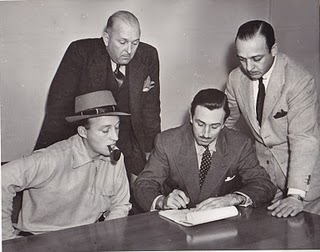
 I just found the following image on the Ward Kimball page on Facebook. The person who posted it said:

 Two weeks ago I met Spanish collector Luciano Berriatua who showed me the above drawing (part of his impressive collection). Based on the type of paper, the size of the paper and the peg system, we can date the drawing as having been created at some point between 1928 and 1935 at the Disney Studio.


 This seems to have been a True-Life Adventures week. I hope I am not boring to many of you, but, for some reason, since I interviewed Jack Couffer the subject has started to excite me. I will have a lot of cool animation-related material to post next week (including a few scoops) but here is one last post about the True-Lifes:
 This just in from Jim Korkis:

 I mentioned a few weeks ago an auidio tour called A Walt in the Park with Rolly Crump that might be worth getting. I have now listened to that program.


 This just in from John Garvin through the Disney Comics Mailing List:


Here is a document I just found online and that I think some of you will enjoy.
Film Music and Its Use in Beaver Valley
As remembered by James Algar in 1950.
This article was first released in Film and TV Music (November-December 1950).
When I went back in retrospect to our discussion of the music before Paul Smith began the Beaver Valley score, and when I began to consider the task of explaining some of our problems to an audience, I remembered an article by Robert U. Nelson published several years ago in The Pacific Spectator. Its title was The Craft of the Film Score. Mr. Nelson
pointed out that music for films and concert music are two different mediums:
“The distinction is important. In writing concert music, the composer is all-powerful; he may write anything he chooses. In the films, all this is changed. The composer is no longer a free agent; he must follow the split-second timings of the cue sheet and he must carefully subordinate his music to the dialogue... Film music cannot possibly follow, excepting in spots where there is no dialogue, an independent, abstract development. Its form is necessarily less tip-lit than that of concert music, its themes and motifs less rigorously worked out. The difference in structure between a film score and a symphony is so apparent as to cause some people to conclude that film music has no form. This is not true, yet the presentation of ideas in a film score is undeniably loose and fragmentary.”
Suppose we see how these observations apply to Beaver Valley.
If the composer must play "second fiddle" to the screen, then his music must follow the tempo, the pantomime and the other accidentals of screen story-telling.
And if he must give way constantly to narration and dialogue, how can he be expected to accomplish anything? Well, the composer can and does make important contributions to a film. Certainly Paul Smith's score was tremendously effective in Beaver Valley.
Film music gives a continuity and a cohesion to screen material; this was particularly true in Beaver Valley. It contributes mood, a feeling of warmth, an emotional tone. It "points up" action, and as you have seen, it definitely adds humor.
The music for Beaver Valley was written after the continuity of scenes had been worked out, after the editing was done and after the narration was written. And so one of the first problems the composer had to cope with was the amount of narration. The audience must hear the narrator, or there is no story, thus the music must be subdued when he is talking. This problem is partially solved by the right kind of orchestration during such passages. But of course the real solution lies in having a plan ahead of time so that the narrator is not talking in those sections where the music is to be most effective. It's a compromise situation of give and take. Indeed, in many spate throughout Beaver Valley the music became the story-telling voice, acting .for the moment, as a second narrator.
In terms of the story he had to help tell, the composer was faced with many other problems when he first sat down to score the picture. These included a hero in the beaver who was so busy and plodding he was unspectacular; a villain in the coyote who threatened but never quite caught up with his intended victims; a miscellaneous cast of characters in terms of the number and variety of animals; a quality in the humor that was sometimes gentle, sometimes playful but rarely ever slapstick. Finally, it had to be remembered that these were real animals, not the usual Disney animals of fantasy. Thus the music couldn't be too weird, or too fantastic or too extreme in direction.
In the beginning, certain musical themes were discussed in terms of the personalities of the animals involved or of the character of the material the music would accompany. It was decided that four main themes would recur throughout the picture.
First the setting of Beaver Valley itself seemed to call for a descriptive theme. We came to refer to this as the "Nature Theme." It was to have simplicity, a certain pastoral quality, dignity, and in general a feeling of the bigness of the outdoors. At the same time it had to be flexible enough that it could stand a bit of musical "embroidery" later when the various animals were introduced. The chipmunk, the moose, the marmot, the raccoon all were brought into the story during this part of the musical development.
Next came the problem of a "Beaver Theme", an important motif that would be heard several times in the picture. It seemed to call for a certain plodding, even tempoed progression to fit the busy animal's personality. And it had to lend itself to development and new coloration as we followed the beaver's fortunes through the seasons.
When the coyote entered the story, we knew we needed a warning note of menace, still the motif had to be short and immediately recognizable in a few notes, for the coyote's entrances and exits were to be sudden and brief.
And lastly the playful otters, whose personality was the exact opposite of that of the busy beaver, demanded a theme of their own. They were everything the beaver wasn't. Where he was serious, they were gay; where he moved cautiously, they went at things with abandon. Otters have as much nervous energy as any animals alive, and apparently never sit still. And so their music was made riotous and lively. The tempo was a lively march tempo, full of spirit and movement; the otter theme was purposely patterned after circus music. In fact, an arrangement was written for the U.C.L.A. band of 110 pieces and the number has become their entrance march at football games. The otter theme also has been adapted in a popular version. Lyrics were written and it now is heard under the title of Jing-a-ling Jing-a-ling. The original theme was such a catchy tune it seemed to lend itself naturally to such exploitation.
There were other somewhat incidental themes in Beaver Valley. They were incidental only in that they solved the problem of a particular episode but were not used again in the score; they proved to be highlights musically. One of these situations was that of the young ducks learning to fly. The music for this bit of action was definitely tongue-in-cheek and written to heighten an already humorous situation. Even the quacking of the baby ducks was made “musical,”… that is, was made to follow the tempo of the theme.
Then there was the Frog Symphony. In this instance humor was derived from the very seriousness of the music. The orchestra played the Sextet from Lucia absolutely straight, and the frogs carried their parts as soberly as opera singers. The effect of course was quite the opposite.
Here then were two instances in Beaver Valley wherein the music definitely heightened the humor. In contrast the episode of the spawning salmon found music called upon for something quite different. Here it had to capture the excitement of the magnificent leaps as the salmon fought their way through the rapids; at the same time it had to suggest some of the menace of the bear; and above all it had to underscore the poignant quality of the salmon's valiant fight.
There is one thing perhaps which sets the Beaver Valley score apart from others of its kind. I believe one of the reasons the music is effective is the fact that we used an animated cartoon technique in a live-action film. Musically speaking, I mean by this that we synchronized our music to our screen pantomime more often and more closely than is generally done in live-action movies. This was attempted not only in the major sequences where the ducks quacked to a tempo and the frogs croaked in unison with the orchestra, but all the way through the picture in little individual situations. The composer once told me he had written his score with a "loving touch". He meant, I'm sure, the musical effects in such scenes as the one where the marmot on the rook yawns and stretches... where the raccoon caught the crayfish, and where the otter poked his head up through the thin ice.
To get this close synchronization requires patience, time and careful planning. It involves a thorough study of the picture by the composer. It means running the picture back and forth on a Moviola while the action is observed scene by scene; it means timing these actions with a stop-watch; it means coping with the mathematics of the problem of so many feet passing through the projector in so many seconds accompanied by so many bars of music to such and such a tempo.
Paul Smith once told me that he definitely tried to write a score that was not pretentious. He said, "I tried to write music that was in keeping at all tines with the picture. I simply tried to do an honest job of scoring." In this, I believe he succeeded.

 One of the most fascinating books I have read in recent years is the three-part biography of Theodore Roosevelt by Edmund Morris. It reads like a novel, while being meticulously researched (I am in the middle of the last volume, Colonel Roosevelt, which has just been released and that I had been expecting for years).
 I learned today with sadness that Lloyd Beebe, one of the key cinematographers on Disney's True-Life Adventures, had passed away yesterday. I mentioned Lloyd often on this blog over the last few months and his life and career will be celebrated through several interviews in Walt's People - Volume 12.

Help Needed!
Once again, I need your help to locate some rare articles and documents.
1. The Bulletin
Do any of you have copies of the 1939-1940 Disney newsletter The Bulletin? Would you then be willing to share copies of some of them?
2. True-Life Adventures
I am trying to put my hands on more material about the making of the True-Life Adentures. I recently stumbled online on the excellent article by Tom McHugh from Popular Mechanics (September 1954) titled Animals are like other People (which I would love to get as a pdf), but I am also trying to locate the following documents:
- The Lurking Camera by Walt Disney in The Atlantic (August 1954)
- Walt Disney's Naturalist-Cinematographers by Frederick Foster in American Cinematographer (February 1954)
- The very rare 20-page booklet titled New Explorations in True-Life Adventures and People and Places (1953)
- The elusive booklet or article titled The Story of Walt Disney's True-Life Adventure Series (1952)
Could some of you help?
 I missed this book when it was released in 2009, but just discovered it through Amazon.it. This catalog of the 37th Mostra of Rapallo with text in Italian and English is titled From Paperinik to PK - A Journey Among the Disney Superheroes. Its authors, are two of the best Italian Disney script writers: Carlo Chendi and Sergio Badino. If you are fan of Disney's Italian comic books, this should definitely be worth picking up.

 I just discovered that Lois Crisler, one of the photographers on White Wilderness had written a book at the time about her experience in the Arctic, called Arctic Wild. I doubt she discusses directly the actual production of that True-Life Adventure but the content of the book is probably directly related to the movie anyway.


Disneyland Mickey Mouse Club Circus / 1955 - 1956
This just in from Todd James Pierce:
[I've seen home movies of the 1955/6 Disneyland Circus before. (I have some, but they aren't particularly great.) But I've never seen the Disney characters in the circus in a home movie.
This looks like a combination of a few things:
The Mickey/Minnie look like the ice show costumes again. Or at least they have the same zigzag cutouts on the mouth.Some--maybe all--of the other characters may have been from the ice show as well.It doesn't look like these dwarfs are from the Carthay Circle premiere in 1938.
Now the interesting part: About five years ago, I was talking to someone who swore she remembered character costumes being made at the studio for Disneyland during the summer of 1955. I filed that away in the "probably mis-remembered" category. But maybe she was right. Maybe there were some costumes made up at the studio that year???]
The same person who posted that clip on YouTube, also posted a rare video of C.V. Wood. See below:
Rare Clip of C.V. Wood / Disneyland General Manager
http://www.youtube.com/watch?v=irrNDs_Z0ZE
 Here is one of the best and cheapest Disney-history-related gift that one can get this year. Don't miss this Walt in the Park with Rolly Crump.

 What would I love to receive as a Christmas gift this year? If Santa Claus were all-powerful, here are some of the Disney-history-related items that would make it to my wish list.