Monday, September 04, 2006


Quite a few new posts these last few days on Toons at War. Also worth checking is Temple of the Seven Camels: in the post titled Another Tribute you will find beautiful documents related to Bill Peet and if you scroll down in the D&D6: Proportion post you will enjoy a fabulous concept drawing of The Jungle Book by my favorite concept artist, Ken Anderson.

Friday, September 01, 2006


Fascinating post on ASIFA Animation Archive's blog this afternoon. Not to be missed.
This story is becoming fascinating thanks to a post by Joakim Gunnarsson "There was an illustrated Chicken Little storybook probably done in the mid 70's (?) illustrated by Tony Strobl. (Released in Scandinavia as a part of "Kalle Ankas bokklubb".) It featured Donald, Goofy and several other regulars. If my memory serves me right the design on the drawing you have reminds me of Strobl's artwork in that book. But it was a looong time ago I last saw that book. Could it be that the project that Ken worked on got shelved and the script etc. ended up in the department wich handled the story books and they used it as a basis for one of their books?"

And I answer: Yes, that's clearly possible. It would be a similar situation to The Gremlins project.

Would anyone have access to the book that Joakim mentions above?

I will be in Italy the whole of next week on a business trip and I am frankly not certain of how much I will be able to post.

Speaking of Italy: would any reader of this blog know someone who seriously collects Disney plush toys by Lars from Italy? (those were created in the '30s, '40s and potentially '50s) I am extremely eager to write an article about those for an upcoming issue of Tomart's Disneyana.

I have the same question regarding the English toys by Chad Valley.


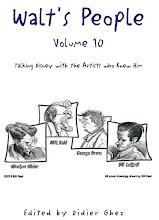
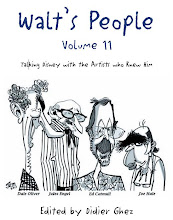
Pete Emslie is really a tremendous artist and I am really a lucky man to have so many talented people helping me with the Walt's People book series.

Pete just sent me yesterday the cover caricatures for Volume 4 and I could not resist sharing them with you all. We are still on track for a late November / early December release.


And here is the last part of Jim Korkis' great series about Walt and polo.

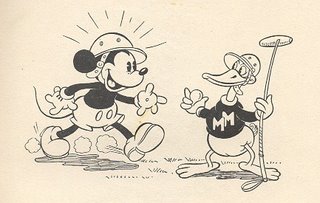
"Mickey's Polo Team was released on January 4, 1936 and directed by Dave Hand whose attention was already focused on his directing responsibilities for Snow White.

There isn't much of a storyline in the cartoon. It is just an interesting premise for physical gags of a polo game between four popular Disney animated characters against a team of four Hollywood celebrities. The spectators in the stands are a mix of Disney animated characters and Hollywood celebrities (Clarabelle Cow kisses Clark Gable, Edna May Oliver sits next to Max Hare, Shirley Temple cheers next to the Three Little Pigs, etc.)

The Mickey Mouse team consists of Mickey, Donald Duck, Goofy and the Big Bad Wolf. The Hollywood team of Movie Stars are Charlie Chaplin, Oliver Hardy, Stan Laurel and Harpo Marx.
While modern audiences may struggle to identify the caricatures of some of the then famous stars like Eddie Cantor, W.C. Fields, Harold Lloyd, even the most astute viewer of classic films on Turner Classic Movies might have trouble identifying the referee.

The referee is a caricature of Jack Holt who was a popular silent screen star who made the transition to talkies primarily in Westerns. In fact, Holt was the father of famous Western movie cowboy star, Tim Holt. Jack Holt was a "manly man" and a strong supporter of polo as terrific physical exercise. He played at the Riviera alongside Walt Disney but is unfortunately forgotten by modern audiences.

This cartoon was made at the height of the Disney Studio's involvement in playing polo. However, this was not the version that Walt originally intended.

There was to be considerable footage devoted to a caricature of Will Rogers. In fact, Disney animators had been sent to Rogers' Santa Monica ranch to sketch the humorist in action.

Rogers was well-known for his love of polo. He even landscaped his own polo field on his estate before he built his house. Upon his death, the estate was given as a gift to the State of California on the condition that equestrian activities continue at Will Rogers Park. It is the home of the Will Rogers Polo Club, the thirteenth oldest polo club in the United States.

In fact, it was Rogers' death in an unfortunate plane accident in August 1935 while Mickey's Polo Team was in production that resulted in his caricature being removed from the cartoon.

Hollywood's interest in polo had already begun to wane and Walt himself would hang up his polo mallet within the next two years. The story of Walt Disney and polo is just another interesting anecdote in the life of an amazing man."

Thursday, August 31, 2006


One more image from the mysterious Chicken Little project.

More Serbian comics, this one from the magazine Koprive, from January 15, 1937.
Reading advices of the day: Ever wonder what a toon funeral might be like? by Jim Hill and Mosquito Fleet insignia on Toons at War.

Crazy day today. Do not expect too many posts.

However, here is the fourth part of Jim Korkis' series about Walt and polo.

"Walt Disney captained the "Mickey Mouse Team" when it came to polo matches. However, many Disneyphiles may be unaware there was also a "Donald Duck Team".

Disney producer Harry Tytle was quite a polo player in college but in the depths of the Depression there were few slots for polo players. However, he did get to play with Will Rogers in August 1935 (which turned out to be Rogers' last game).

He also knew Harold Helvenston who was a professor of Dramatics working at the Disney Studio at the time. One night at dinner, through the kindness of Helvenston, Tytle met some Disney employees including George Drake and Perce Pearce and found himself hired at the Disney Studio in the traffic department.

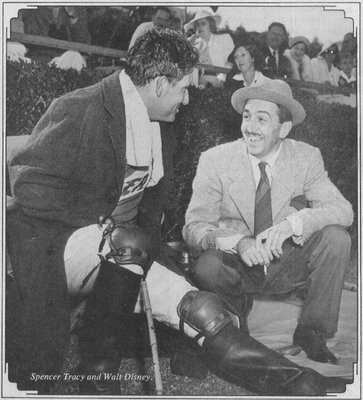
Once at the studio, Tytle was introduced to Walt as a polo player and found himself invited to play with Walt at the Victor McLaughlin Arena. Walt must have liked the competitive spirit of the young man because Tytle also found himself playing with Walt at the Riviera Country Club against Spencer Tracy and his family.

Tytle, who didn't have the artistic skill to compete with other aspiring animators at the studio, found himself pinch hitting in many different departments at the Disney Studio.

However, he still had time to teach polo to a group of editors and cutters from other studios, played polo for the Junior Chamber of Commerce and formed the "Donald Duck Team". The "Donald Duck Team" (including people like Mel Shaw and Larry Lansburgh) played a wide area as far off as Arizona. They once took the group down to Mexico City in 1938 and won their match.

Tytle thinks the team won because they were constantly being underestimated because they had a portrait of Donald Duck emblazoned on their shirts. "A clever touch suggested by Walt," remembered Tytle in his autobiography.

What do Shirley Temple, Cock Robin, Charles Laughton, Clarabelle Cow and Jack Holt have to do with Disney and polo?

The story concludes tomorrow....."

Wednesday, August 30, 2006

The Marathon (1989)


This is probably the most moving tribute to the Mouse I have ever seen. I dreamed for years of seeing it again and thanks to Ross Anderson I have now been able to post it on YouTube. It was created by Russian animators Mikhail Tumelya and Alexander Petrov for Mickey's 60th birthday and shown to Roy Disney during his trip to Moscow.

It was produced by I Boyarsky and A. Zalessky at The School for Advanced Studies for Screen Writers and Directors Beyelorusfilm, with Soyuzmultfilm Studios in Moscow.

"Really, quite literally, we all wound up hugging each other with tears coming down our faces... it was one of the more emotional moments that I can remember in my life." Such was Roy Disney's reaction when he and a group of Disney executives first saw The Marathon.


Here us the third part of Jim Korkis' great series about Walt and polo (yes, that is Walt on the right):

"In 1934, Roy Disney bought four polo ponies. At one point, Walt had over a dozen horses in his stable.

Walt was neither athletic nor coordinated. One Disney employee wondered aloud how Walt was able to stay on the horse and swing the mallet at the same time.

Unlike other young boys, Walt never played sports. For most of his childhood, he got up at three o'clock in the morning to deliver newspapers and then rush to school. At lunch time, he ran across the street to a local business to do errands and cleaning up in exchange for a hot lunch. After school, he would have to run home to deliver the evening edition of the newspaper and then come home to do homework, eat dinner and get ready for the routine to begin the next day.

Walt compensated for this lack of learning sports skills by being a focused competitor. Actor Robert Stack who was a teenager at the time remembered that Walt would "run right over anybody who crossed the line." At his home, Stack still has some trophies with Walt's name on it commemorating some of the matches they won while playing together.

Will Rogers was even more aggressive and lost a few fans with his attempts to hog the ball all the time.

However, by 1938, Roy Disney was becoming worried that the combination of Walt's aggressiveness and the inherent danger of the sport itself might rob the Disney Studio of its visionary. Walt resisted that suggestion to hang up his mallet even after he had been in two matches where fellow horsemen had suffered fatal injuries.

Always pushing himself, Walt eventually wanted to play with the better players. There was a South American team (known as "The Argentines") who were practicing on a field at the Riviera and Walt wanted to practice with them. Even then, it was almost impossible to tell Walt "no" so Walt took the field. One of the players hit the ball just as Walt on his horse was turning around and the ball hit Walt hard enough to knock him from the saddle.

Walt had four of his cervical vertebrae crushed and was in tremendous pain. Instead of seeing a doctor, he went to a chiropractor who manipulated Walt's back. Sadly, the injury might have healed if Walt had been placed in a cast. Instead, it resulted in a calcium deposit building up in the back of his neck that resulted in a painful form of arthritis that plagued Walt for the rest of his life.

In his later years, Walt required a couple of shots of scotch and a massage from the studio nurse in order to get home at night. When he went into St. Joseph's Hospital for the final time, it arose no suspicion when employees were told Walt was taking care of an "old polo injury".

Both Walt and Roy sold their polo ponies although Actor Fess "Davy Crockett" Parker has said that during one of the early parades at Disneyland, he and Walt rode on Walt's polo ponies resulting in the extremely tall Parker having his feet dangling over the side of the horse.

Believe it or not, the story continues tomorrow...."


Is there really no one out there who would be able to tell us something about this mysterious project?

From Veseli Cetvrtak (Joyful Thursday) 18 from May 5, 1932.
Good reading this morning: Bright as a Disney Penny by Wade Sampson.

Tuesday, August 29, 2006


Major event. I have been aluding to it for weeks. Here are the details: A major exhibition of Disney art, at least 70% of it never seen before, is about to start in Paris.

IL ÉTAIT UNE FOIS WALT DISNEY, Aux sources de l'art des studios Disney will open at Galeries nationales du Grand Palais Paris on September 16, 2006 and will last until January 15, 2007. It will then travel to Museum of Modern Art Montreal where it will open on March 8, 2007 and close on June 24, 2007. There are rumors that it might then travel to other major museums around the world.

Make no mistake, this is a multi-million dollars exhibition taking place at a museum in Paris that is almost as important as Le Louvre. I do not recall that Disney art was ever exposed in such a presitigious venue in France in the past.

The basis for the concept of the exhibition is Robin Allan's book Disney and Europe that explores the European artists and European works that influenced Disney movies until The Jungle Book.

I will attend the inauguration on September 14th and (if photos are allowed) will provide a fully illustrated report about it the following week.

Andreas Deja, Charles Solomon, Robin Allan and Pierre Lambert will attend. Will any of the readers of the blog be there to? If so, please let me know!


As promised, here is the second part in Jim Korkis great 5-part series about Walt and polo:

"The popularity of Mickey Mouse in the early Thirties was a mixed blessing for Walt Disney. The stress of running and expanding his studio and the demands being made in other areas as varied as merchandising and publicity as well as stress at home with his wife Lillian suffering through two miscarriages drove Walt to one of his infamous breakdowns.

Walt's doctor suggested that Mickey Mouse's father take up some form of exercise to help relieve the stress. Walt tried wrestling, boxing and golf but each attempt only frustrated him further rather than releasing the tension. Walt had always loved horses and he took up horseback riding and joined a local riding club.

Walt was a great multi-tasker and it occurred to him that he could combine his love of horseback riding with his desire to integrate with Hollywood society by taking up the then highly popular port of polo.

Originally, Walt enlisted Jack Cutting, Norm Ferguson, Les Clark, Dick Lundy, Gunther Lessing, Bill Cottrell and even his brother Roy to participate. They studied the book "As To Polo" by Cameron and had lessons and lectures by Gil Proctor, a polo expert. Eventually, they did riding practice in the San Fernando Valley from six in the morning until they had to report to work at the Disney Studio at eight.

Walt even built a polo cage at the studio so that during lunch breaks, the men could sit on a wooden horse and practice hitting the wooden ball into a goal. Finally, they started participating in matches with similarly inexperienced teams at the stadium on Riverside Drive. Walt and Roy would play regularly with their employees on Wednesday mornings and Saturday afternoons.
In addition, Walt and Roy joined the prestigious Riviera Club where such Hollywood luminaries as Spencer Tracy, Leslie Howard, Darryl Zanuck and others held court on the playing field. Roy Disney was a fair player but Walt was highly aggressive.

One of the major players in these matches was Will Rogers. Walt liked the folksy humorist and had been in discussions with him to star in Walt's first full length animated feature film, "Rip Van Winkle".

"Snow White" was not the first choice of a feature project for Walt. He had developed several possibilities including "Alice in Wonderland" featuring a live action Mary Pickford interacting with animated characters. When that project fell apart, Walt considered using the same concept but with Will Rogers as Rip Van Winkle interacting with animated characters.

Disney historian J.B. Kaufman discovered that group of Disney animators including Art Babbitt, Grim Natwick and Bill Tytla had been taken to Will Rogers' ranch in Santa Monica to make sketches of the comedian in action. Although this session might have been for another Disney cartoon that never featured Will Rogers.

The story continues tomorrow..."


One more Ken Anderson drawing from the mysterious Chicken Little project.

From Veseli Cetvrtak (Joyful Thursday) 18 from May 5, 1932.
Three interesting posts to read this morning: All About Charlie (Charles) Byrne on Cartoon Brew, Walt Disney's Volunteer Army and Donald Duck - "What's Cookin'??" on Toons at War.