Wednesday, August 16, 2006


I mentioned last week the 1947 book by Lo Duca Le Dessin Anime, for which Walt had written an introduction. I found time yesterday evening to translate that introduction. Here it is. Remember however, while reading it, that it was originally written in English, then published in French, then re-translated in English gathering aproximations with each translation.

While researching the web to find a nice picture of Walt to illustrate this post, I stumbled about this photo of him with French actor Jean Sablon which I had never seen before and which I could not resist sharing.

"In our animated features, we avoid, as much as we can, having to deal with human beings. Let Hollywood do it. We have our own kingdom in which animals and even animated objects talk, think and act like human beings, but in a more appealing way. It’s an enchanted and magical world which is suited to this new breed of poetry. But animation went beyond this limited world of art.
Can we give to animation a role in the future re-building of the world? Will it be able to sustain new ideas? How will it contribute to train new habits and features of character?
I do not pretend I know the magic spell, and I do not pretend to be a teacher or a sociologist. But, along with other men who have a deep understanding of animated cartoons, I state that this art has an impact on all of human activities.

Let’s not forget that during the war, the same people that had created Snow White, Bambi, Fantasia, The Three Caballeros and even Donald Duck, tackled technical matters, their work being controlled by strategists and tacticians. We discovered that way a teaching tool of such value that it could be used for other goals.
It is without a doubt that in the mind of the teachers of the future animation will be one of the most flexible and stimulating tools for teaching. It will be enough to know how to use it.
One of the key tasks for animation today is to help inserting again into a normal and productive life millions of men and women whose life was hurt by the war. They have to be trained and taught once again.
I can imagine the ideal training movie as a reel that would link one man’s work to each phase of his life, or, even better, that would combine the different aspects of his life like mind and body.; his personal safety or his family’s safety, his home and his country, or even his sense of human friendship. Such a movie – or such a series of movies – would have to include facts of every day life: food, love, play, rest, meditation or laughter.
When such a man will have “awaken”, ready for a true social life, he will decide to improve himself in his work. As a physicist, a plumber or an engineer, he will have access to the movies that will allow him to move forward in his specialty. Migrations of people, structure of societies, philosophical principles, mathematical knowledge, sea streams, new laws of electronics will be explained on film and will become clear to everyone. Every technical problem can therefore be overcome. But one has to be able to use rationally this new principle.
Animation goes beyond borders. Cartoons speak all languages. What we create in the US can be shown in France or in Germany, in India or in Japan, through the world of children and adults. That’s where both artistic cartoons and educational cartoons find their meaning.

The word of animation is the world of our imagination, a world in which the sun, the moon, the stars and all the living things are run by us. We harvest a small character in our imagination and, if he disobeys us, we erase him with a rubber. Our tools are those that the mind can imagine and that the hand can draw, the whole of human experience: the real world of war and peace and the world of dreams, color, music, sound, and most of all movement. It’s a fascinating activity, but to explain it we have to mention pegs and exposure-sheets, frames and sketches, time spent in the sweatbox and acoustic tempos. The history of animated cartoons is in itself of huge web of intertwined data."


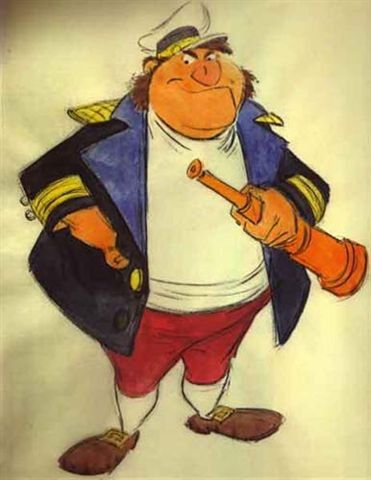
Definitely worth reading today, if you have not done so yet, is Floyd Norman's latest article on JimHillMedia about his work on Windwagon Smith.

There will be a lot of material related to Floyd Norman in Walt's People - Volume 4, including quite a few stories he has not yet told on JimHillMedia and I hope to include this text in Volume 5.


One of the sites I visit each morning is The Animation Guild's blog. Maintained by Steve Hulett, son of veteran Disney background artist Ralph Hulett, its archives are full of fascinating anecdotes about Disney history during th '70s and '80s.

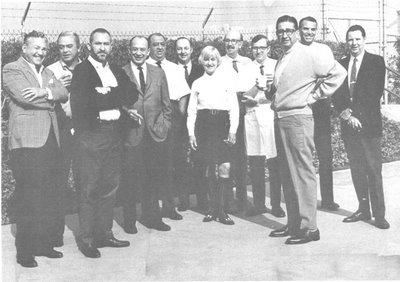
Steve just posted this photo of some members of the Imagineering crew, which I had never seen before, along with an article identifying each of them.

Just to end up the day nicely, here is the last Horvath drawing in the series I started showing last week and that was sold a while back by Van Eaton Galleries.

If you have access to photocopies or scans or Disney concept art, storyboards or artist gag drawings and caricatures, I would love to show them on the blog!


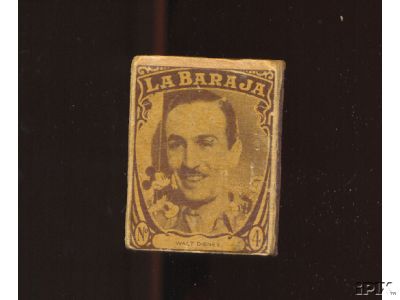
With all the talk about Cuba these days, I thought I might want to show you this splendid matchbox that was created in the island in the mid-'30s. I saw it once on ebay but did not bid high enough to get it, unfortunately.

I intend to write an article about vintage Disneyana from Cuba for Tomart's Disneyana at some point in the future (there were great "sticker" albums and at least one beautiful unauthorized "Disney" primer created in the island before it became communist) but for this I would need a much better scan of this matchbox. Would any of you have it in their collection?


It was a holiday in Spain yesterday, hence my silence. I will usually not post on weekends, holidays and while travelling for business. But there might be exceptions.

This being said, let me share the email I received yesterday from Are Myklebust, which will help you start your day with great historical material:

"Hi Didier!
In the latest issue (August 11, 2006) of Scoop there is an interesting notice about an article in “Motion Pictures Herald”, from October 1, 1932 related to Mickey Mouse and the Walt Disney Studios – including scans of the magazine pages.
What’s really the exciting stuff here (at least for me) is the ad with the listing of Walt’s staff in 1932 (including the Comic Strip Department)!
Are Myklebust"

Monday, August 14, 2006

Ettore D'Agostino, one of the readers of the blog just sent me the following email:

"Your post about Cri Cri el Grillito Cantor has been a wonderful surprise for me and for my friends who didn't know the existence of a special Three Little Pigs short. I think that through the years, many artists from all countries in the world have created special undiscovered treasures inspired from the Disney universe. For example here in Italy, there was a famous cartoonist and comics author, Romano Scarpa (his stories are very popular here in Italy and are reprinted by Gemstone Publishing in the USA), who got a production license from the Disney Studios and made a short called Camminata Disney in 1982. An edited version was used as the opening of an Italian anthology TV series about Disney.
The plot is quite simple. The most popular Disney characters from Disney comics are featured such as (in order of appearance) Donald Duck, Horace Horsecollar, Daisy Duck, Clarabelle Cow, Minnie Mouse, Huey, Dewey, Louie, Goofy, Detective Casey, The Phatom Blot, Mr. O’Hara, Superduck (in Italian we call it Paperinik), Gyro Gearloose, Scrooge Mc.Duck, Brigitte MacBridge (one of Scarpa's creations for the comics), the Beagle Boys, Gladstone Gander, Peg Leg Pete and Paperetta Ye Ye (another of Scarpa's creations which is very popular in Brazil). The crowd is directed to the Sequoia TV Station where the show will start. An Eagle, who is responsible for the security of the studio, is worried about all those people coming to the studio, so, by using a special X-ray machine, he checks the contents of the bags the characters are carrying. He's shocked when see that Huey, Dewey and Louie are carrying dangerous objects such as a bomb, a dagger and other weapons. But in the next sequence we discover it's only a joke by the three nephews: the 'dangerous' object are 'silhouettes' they have put in their bags to make light of the Eagle. At the end, after other gags, the Eagle yields ("If you can't beat them, then join them") and all characters enter the Studio where Mickey with his assistant Bruto (Ellsworth's adoptive son) presents the show of the day.
Here you can find, some videoclips, screen-grabs and storyboards (the website is by Francesco Spreafico); the storyboards are from the book Romano Scarpa, Sognando la Calidornia by A.Becattini, L. Boschi, L. Gori, A. Sani.
In the ’80s Scarpa also made a wonderful animation test (30 seconds, with Scrooge, Huey, Dewey and Louie and the Beagles Boys (Duck Tales model sheets were used) about Duck Tales, but finally Japanese studios were able to take the license for the TV series: an Italian independent studio wouldn't be able to produce the number of shorts needed for a syndicated TV series."
Speaking of which: does anyone have access to that amazing "homage to Mickey" short that was produced by an independent artist for Roy E. Disney's visit to the USSR during the Perestroika era? It featured Mickey as a black shadow on the left side of the screen and a man in dark shadow on the right side, both seen in profile. They are both dancing and the man gets older while Mickey always stays the same. I have goosebumps just remembering it. It's an extremely beautiful homage and one I would love to see again.

It's never "today's last post"! Especially when I discover a book about Disney that I had never heard about before. Check this post on Michael Sporn's splog to understand my excitment. I hope Michael will post more scans soon.


One last post for the day.

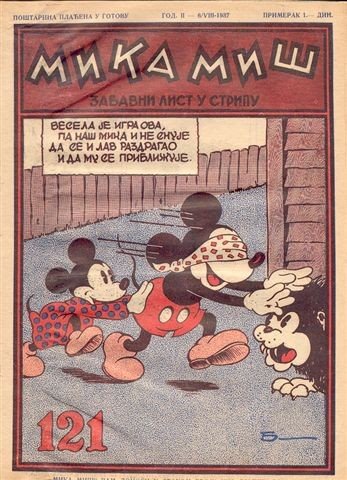
Here is an issue of Mika Mis magazine (former-Yugoslavia) from August 6, 1937, with a color cover created by Vlastimir Belkic. Very rare as there were two versions of the cover, the other one being more spread up and in black and White.


Among last week posts on this blog was one by Ken Priebe, that links to two very nice short interviews with former Disney artists: one with Bill Matthews and one with Ken Southworth. I love the three stories told by Ken about his experience at the Disney Studio, especially this one, involving Ward Kimball - who else?

"Ward Kimball, who as a top animator, had his own room, was gazing out the window one rainy day (it does rain in California), when the door opened behind him. After a suitable pause, he turned, and there was WALT! Never at a loss, Ward just said in a hearty voice, "Just studying effects, Walt, just studying effects!" I imagine Walt had a good laugh!"


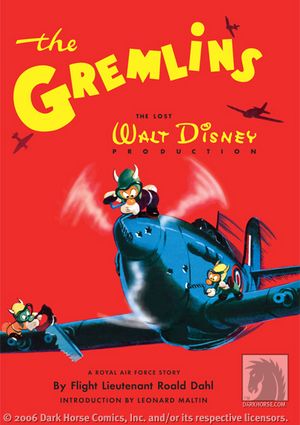
Why was The Gremlins project abandoned?

Here is Kimball's take on it, from an interview with Richard Shale: "Walt never could decide in his mind what a gremlin should look like. It was as simple as that. Is it a little brownie? Is it... of course, a gremlin today would be easy to design in our open-ended imaginative way of going about things, but in those days, with everything so confined to a certain technique and Disney style, it was impossible. I think Walt got frustrated and gave it up."

... and T. Hee's version, from an interview with Richard Hubler: "This was prior to 1946, during the war. I was ready to go home and started walking out towards the parking lot. Walt was behind me and caught up with me and said, “Where are you going?” I said, “I’m going home.” He said, “I’ve got to go out here to see some RAF flyers out in Bel Air, talk about the Gremlins. You want to go along?” I said, “Yeah, sounds good, but I’d better call my wife and tell her I’ll be late.” He said, “Okay.” So I called my wife and said, “I’m going out with Walt to Bel Air and will probably eat out there somewhere so don’t wait dinner for me.” She said, “What time will you be home?” and I said, “I don’t know.” So, on the way down he talked all about this gremlin film, about these little guys that came out on the wings, saving the RAF flyers and everything. We got down to this kind of a deep canyon and a big old house and it was colder and foggier than hell down there. The windows were open in every room, with windows from ceiling to floor, the doors were open. The RAF men were all in their uniforms and the British women were in there with their low cut, sleeveless gowns and Walt and I had our overcoats on. We hesitated about taking them off because it was so God damned cold in there but they had fireplaces going in every room. Finally we took them off and they served us drinks and these were the typical RAF flyers - like the Terry Thomas guys - with the big moustaches, the whole thing, you know. They were talking in that very, very British, clipped way - very difficult to understand and the women were even more British. Both of us being Midwesterners I think that that kind of grated on our ears, but most of the evening, before we had dinner, most of the RAF flyers were in the den and they were telling off-color stories and Walt was laughing at them because they were funny. But he wasn’t there for that, he was there to talk about the gremlins for the film. Every time he’d bring it up, why they’d get off on some other tactic about their experiences. So we had dinner and I could see that Walt wasn’t too happy because he couldn’t get the conversation back to the gremlins. We left late, pretty close to midnight, and we got in the car and he was silent and I said something about, “You know what you could do with those gremlins...” He said, “I’m not going to do the film.” I said, “You’re not?” And that was the end of it."

Both interviews are schedulded to be released in Walt's People - Volume 5.


For those of you who will be visiting Disneyland Paris, I am glad to announce that the English version of my book Disneyland Paris - From Sketch to Reality is again available at the Park. The chapter on Discoveryland has been slightly updated to take into account Buzz Lightyear and Space Mountain: Mission 2.
For the most serious fans, I still have two or three copies of the original limited edition for sale. That one is unlikely to ever be re-published (that's an understatement).
For more about "The Lost Caballero" that Jenny Lerew made us discover a few weeks ago on The Blackwing Diaries, check the excellent article that Wade Sampson recently published on Mouseplanet. That's a "must-read" and a great way to start the week.

Friday, August 11, 2006


Amid Amidi's Animation Blast is clearly one of those magazines any serious Disney historian can't live without (as used to be Funnyworld and Persistence of Vision) and as still is The E-Ticket and Tomart's Disneyana in their respective categories. Issue 9 that features a tremendous article by Pete Docter about John Sibley is a must-read.

All this being said, I was stupid enough not to buy a copy of issue 3 at the time of its release and I was wondering if any of you would have a spare copy to sell as it is now sold-out.


(This scan was improved by Disney History blog reader Galen Fott).

Dennis Books, an extremely serious American collector of original Disney art and vintage Disneyana, as well as a good friend for years, sent me an email yesterday to mention that he had posted scans of part of his collection at www.comicartfans.com Among the items that he shares, is this series of caricatures by Mouse-man Floyd Gottfredson.

I was wondering if any of you would recognize some of the artists or executives that Gottfredson caricatured.


As promised yesterday: Oko ("The Eye") number 10 (March 7th, 1936) from Croatia.
Comment! Email me! Participate!

What makes this blog fun is getting feedback and enlightning emails from some of you. No email about Disney history ever bothers me.

And I am also looking for contributors to the blog. Specifically:

- If you have great stories about Disney history and Disney artists that have not been published in books before, send them for publication on the blog.

- If you have very unusual elements of Disneyana, show them to me. If they are isolated elements I will feature them on the blog. If you have a whole collection and they are from outside of the US, we would discuss creating a special article about them for Tomart's Disneyana.

- Did you particularly like a book about Disney history that has just been published? Send me your in-depth review for publication.

- Do you have access to great never-seen-before Disney art (concept art, storyboards, caricatures,...), please, please send scans. There is nothing that I like to see more than this.

- And most of all: do you have access to interviews with Disney artists, or great written documents about Disney history in any shape or form? Please share them. They will either serve as reference material for future Walt's People volumes or I will talk to you to get the rights to publish them in book form.

Thursday, August 10, 2006


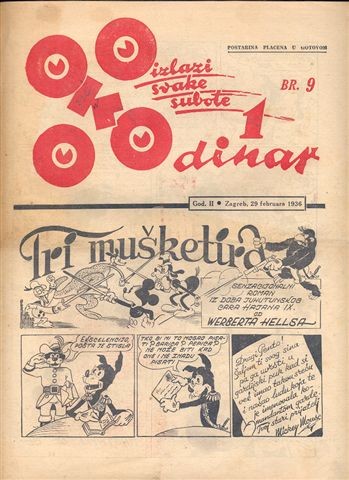
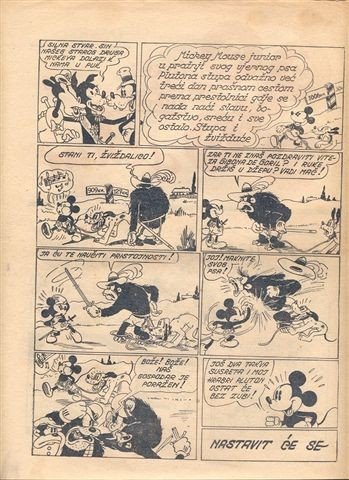
Those two pages drawn by a local Croatian artist (and obviously re-using some Gottfredson art too) come from the Croatian magazine Oko ("The Eye"), number 9, from February 29, 1936.
I wrote a long article about Disney magazines before 1945 in former-Yugoslavia for Tomart's Disneyana, but had not discovered those at the time. I will post two more pages tomorrow.
Here is the Table of Contents of Walt's People - Volume 4 that should be released at the end of this year:

JB Kaufman: Virginia Davis
Grim Natwick: Homage to a Star
Joe Adamson: Dick Huemer
Brian Sibley: Dick Huemer
Dick Huemer: Huemeresque 1 and 2
Mike Barrier: Joe Grant
Jim Korkis: Peter Ellenshaw
Armand Eisen: John Hench
Armand Eisen: Marc Davis
Dave Smith: Lou Debney
Charles Solomon: Stan Green
Charles Solomon: Leo Salkin
Christian Renaut: Dale Oliver
Alberto Becattini: Dick Moores
Alberto Becattini: Roger Armstrong
Don Peri: Roy Williams
Didier Ghez: Brian Sibley
Christian Renaut: Ted Berman
Floyd Norman: The Other Fred
Floyd Norman: The Bullpen
Celbi Pegoraro: Floyd Norman
Christian Ziebarth: Eric Goldberg
Pete Emslie: Cover Art

See why I am excited?!


I believe that none of you will be surprised if I mention The Blackwing Diaries as one of the best sites on which to find Disney animation history these days, especially if you are a fan of Freddy Moore (and who isn't?) Jenny Lerew has been posting many drawings from the collection of James Walker and none of you could afford not to visit her blog.

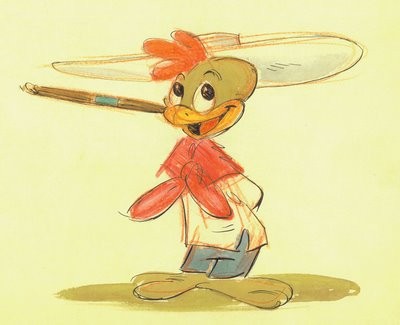
The drawing above is one of those Jenny has been posting. You will not find others in the future here, as I have no intentition whatsoever of pirating Jenny's site. The little rooster, however, has an interesting story that I believe is worth mentioning and that historian JB Kaufman shared with me and Jenny a few weeks ago:

"There was supposed to be a third Latin American feature after Saludos Amigos and The Three Caballeros. The plans for it fluctuated quite a bit, as they did for the other two, but the title probably would have been Carnival, and it was definitely supposed to include a segment on Cuba. Fred Moore didn't go on the original South American trip in 1941, but he was part of the smaller group that went on a similar research trip to Cuba in September-October 1944. In planning the proposed Cuban film the studio tried to develop a character that would represent the country, in the same way that Joe Carioca represented Brazil and Panchito represented Mexico. Their tentative solution was a "guajiro" or "kikirigui" -- basically a fighting cock, but this was the popular name for a scrawny little bantam rooster, known for having a lot of attitude and not much of anything else. Moore was specifically assigned this character, and Norm Ferguson, the supervising producer, was counting on the inherent appeal of Moore's drawings to put the character over. The designs varied a lot and I'm not sure any final design was ever approved, but I think the drawings published by Jenny Lerew represent one phase of the character.
It's a long story, but basically the third Latin feature ran out of gas and was never finished. The Cuban segment was scrapped altogether, and some of the other ideas evolved at the Disney studio in surprising ways (Destino was one of them). The one segment to survive in something like its original form was Blame It on the Samba, which as you know was incorporated into Melody Time in 1948."

It is to be noted that JB wrote a book about the Disney Latin American films of the 40s, from the 1941 South American trip through the making of the films, which will hopefully be published soon.