Thursday, May 26, 2011

This just in from Phil Rushton:

[You might be intrigued by some pages that I recently came across in the first three issues of IPC's obscure 1972 educational magazine Walt Disney's Now I Know. While most of this publication was taken up with relatively uninteresting facts and puzzles it also included a handful of fascinating historical features in which cartoon characters such as Mickey Mouse and Donald Duck were incorporated into realistic scenes that seem to have been specially painted by top British comic artists (almost like a reversal of the live-action/cartoon sequences used in films such as Mary Poppins). For example I'm not sure how much involvement they had with the principal cartoon characters seen but it's clear to me that the examples below were mostly drawn by Patrick Nicolle and the great Ron Embleton (of Wulf the Briton and Trigan Empire fame).

Here is also the cover of issue no.1 in which the Pat Nicolle page appeared (I'm not sure of the artist in this case), and the second half of the Ron Embleton feature on Ancient Egypt from no.2 (the continuation of this in no.3 was illustrated by Angus McBride - another well-known British artist).

Now I Know, like its companion Disneyland, was produced in London by the editorial team responsible for Look & Learn (home of the famous 'Trigan Empire' strip) in association with the Disney Studios in Holywood.]


Wednesday, May 25, 2011

This just in through Julie Svendsen.


Monday, May 23, 2011


I had the pleasure to receive last week thanks to John Wigmans and Phil Rushton the autobiography of English artist Basil Reynolds, one of the two key artists of the 1930s Mickey Mouse Weekly, along with Wilfred Haughton. The autobiography had been published by Denis Gifford in the English fanzine The Illustrated Comic Journal.

I will release this document in a future issue of Walt's People.

As Jim Korkis (and Calvin and Hobbes) reminded me: "There's treasure everywhere."
Do not miss today:

- Historic 1928 Disney announcement by David Lesjak
- Coming by popular demand! 1929 Mickey Mouse ad by David Lesjak
- And you call that a vacation? by David Lesjak

Sunday, May 22, 2011

This just in from Amid Amidi:


[Not sure if you know, but that famous caricature of Walt was drawn by Milt Kahl.

Enclosed is the proof I found in one of Ward's photo albums =)]

Friday, May 20, 2011

I have just picked up this great French 1930s needle kit and I thought you would enjoy seeing it. It was prodiced by Charles Leruth & Cie. in Aix-La-Chapelle.
Do not miss today:

- Chronicle’s Fall 2011 Animation Books by Amid Amidi
- Paul F. Anderson shares the untold history of the war years at Walt Disney Studios by Jim Hill
- ALICE COMEDIES ad June 21, 1925 by Mark Sonntag
- Don Rosa's Never Published Disney-MGM Comic by Jeff Pepper

Thursday, May 19, 2011

This just in from Are Myklebust:

[Here is the link to the website of a Swedish female modern artist, who has made a real life model of the interior of the trailer from the classic Mickey Mouse short, “Mickey’s Trailer” (1938) - that even works! There is also video of the process on her website (just click on one of the images). Quite amazing!]

Wednesday, May 18, 2011

This just in from Mark Sonntag:

[A few days ago Cartoon Brew posted a link to Film Daily scans available online. Here's some of my favorites which I've uncovered. I really love the Skeleton Dance ad. Feel free to post them. I've uncovered a bunch of reviews for the Alice, Oswald, Mickey and Symphonies shorts which I'll post next week. I should be storyboarding, but this was too exciting.]


Do not miss today:

- A Walt Disney World Duo - Golf Championship and the First Candelight by Jim Korkis
- 1922 Laugh-O-Gram ad and a 1925 Disney biography by David Lesjak
- ALICE GETS IN DUTCH review by Mark Sonntag
- THE SKELETON DANCE ad by Mark Sonntag
- PLANE CRAZY write up by Mark Sonntag

Monday, May 16, 2011


This just in from Jim Korkis:

[There is a "lost" book written and illustrated by Disney legendary animator and director Jack Kinney in the late Seventies It was roughly 135 (xeroxed) pages and done for the Institute for Career and Vocational Training in Culver City, California (Executive director at the time was Ira Englander). The cover was done by Jack Kinney and proclaimed that the the title was "Learn Animation: It's Your Move". However, the title page claims the manual is actually entitled "Animation: A Piece of Paper And A Pencil and You" by Jack Kinney. There is no copyright anywhere in the book.

It terms of a manual of how to do animation, it is hopelessly outdated and its long glossary of animation terms seems as relevant as describing the parts of a buggy whip. In terms of the history of animation, there are no anecdotes or references that would help connect the dots. This is a straight forward basic "how to animate" book with no stories. While the book does xerox off examples of certain artists like Heinrich Kley and some badly washed out photos, the real treasure in the book are the previously unpublished drawings by Kinney himself. Just like the more famous Preston Blair book, there are pages and pages and pages of Kinney showing how to do character construction, expressions, lip sync, gags, and more. For a true Kinney fan, the joy is that occasionally he will include a sketch hidden in with dozens of other sketches of Mickey Mouse or Popeye or even Disney storyman Roy Williams to illustrate his point. Those drawings by Kinney are probably the only reason for a Disney fan or animation fan to try to track down a copy. ]

This just in by Greg Heberlein:

[I bought a Walt-autographed Simon & Shuster Art of Animation last year from Howard Lowery. Since there was no dust jacket, I shopped for another copy so I could put a dust jacket on the autographed copy. The second book turned out to be a 1958 Golden Press publication, the one in which the dust jacket matches the Golden Press book's cover as well as the Simon & Shuster dust jacket. Do you know anything about how the Golden Press edition came to be? Although mine has a 1958 publication date, it includes material into the early 1960s.]

Could anyone answer that question?
This is a French mystery novel, which I saw in a bookshop two weeks ago while on vacation. Horrible enough for me not to be the only one to have bad dreams about it ;-)

Sunday, May 15, 2011

I was looking recently for any possible information about a Disney secretary who was part of one of the short cartoon units at the Studio in the '50s. I was not expecting to find anything. But I did: she was listed among the credits of a Disney short... in one place only, a page of the book Animated Film Encyclopedia: A Complete Guide to American Shorts, Features, And Sequences, 1900-1979 by Graham Webb. This caught my attention. Having reviewed that book in more details, I realized that it was the tool I had been looking for for years: a place where one can find detailed credits of all the Disney shorts (or at least all the shorts created for general release), including most or all of the animators who worked on each short, the layout artists, the story men, etc!

This is a treasure trove for researchers when it comes to reference books. I am still puzzled as to how Graham pulled it off: by checking all the animator drafts? By getting the information from some of the artists? In any case, to me the result is priceless. Graham is working on a second edition which will be released shortly. I will try and interview him soon for this blog.

A note of caution: there are several versions of the first edition of the book, including one in two volumes. I believe I am linking to the complete-one-volume set.


Do not miss today:

- The Mysterious Jack... by Steven Hartley
- Lost Treasures - Adventureland by Maxime
- Lost Treasures - Frontierland by Maxime
- Lost Treasures - Fantasyland by Maxime

Saturday, May 14, 2011

You should check this article which has just been released on http://www.awn.com/ (forget the two or three typos it contains). I was particularly frustrated at the Blogger outage this week as it prevented me to share with you yesterday morning this great shot of Freddie Moore and Art Babbitt which Jake used to illustrate his article.

Thursday, May 12, 2011

This book seems to be pretty well done and I will pick up my own copy soon.


Do not miss today:

- New Disney History Discoveries by Jim Korkis
- "Working with Disney" gives you an up-close look at Walt Disney, the man by Jim Hill
- SAMLAND - Disney World Essentials by Sam Gennaway

Wednesday, May 11, 2011

Although this book is aimed at kids, I have a feeling it might contain some good information about former Disney artist Wah Ming Chang. I will let you know as soon as I get it.
This just in from Carlene Thie. I have a feeling that this could be an interesting DVD. (I have not seen it yet)

Monday, May 09, 2011


I am not yet sure if this new book by Bear Manor Media contains much about James Sheldon's work for Disney, but I will soon find out when I get the book. I am also planning to interview Sheldon in the near future.
The table of contents of issue 16 of Tales of the Laughing Place has been announced and there is a lot I am looking forward to in it.

This just in from S/R Labs.


Do not miss today:

- Forgotten Dreams: The Woodcutter's House by Jeff Pepper (Great stuff)
- Disney’s “Understanding Stresses and Strains” (1968) by Jerry Beck
- The Social Side of Health
- Steps Towards Maturity and Health
- Mary Blair, Fred Moore and Some Other Dude by Amid Amidi
- Two new books you MUST buy! by Jerry Beck
- Letter from Charles Mintz by Mark Sonntag
- Dick Van Dyke's memoir reveals what it was really like to work with Walt by Jim Hill
- The Forgotten Story of Dixie Landings by Jim Korkis
- The Sad Song of the South by Jim Korkis
- Bonus Sunday on Vintage Disneyland Tickets

Monday, April 25, 2011

We are taking a long-deserved vacation starting tomorrow, traveling to the North of Spain and the South-West of France. The blog will be updated again on May 9th.
Walt's People Update

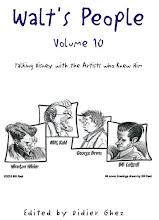
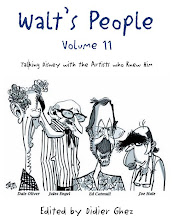
I spent a big part of this long weekend working on Volumes 11 and 12 of Walt's People, which I believe will be spectacular. Here is a glimpse at the table of contents of Volume 11. As you can see I am including a large section about Disney during the '50s (without neglecting the Golden Age of the Studio), and have started to open the doors to the world of WDI. The interview with Ed Catmull, conducted last week, does contain a few small scoops.

Foreword: John Canemaker
Didier Ghez: Ruthie Tompson
Christopher Finch & Linda Rosenkrantz: Walt Pfeiffer
John Culhane: Shirley Temple
John Culhane: I. Klein
Peter Hansen: Basil Reynolds
Christopher Finch & Linda Rosenkrantz: Eric Larson
John Culhane: John Hubley
Robin Allan: Jules Engel
Darrell Van Citters: Ed Love
Darrell Van Citters: Mike Lah
JB Kaufman: Frank Thomas
Dave Smith: Carl Nater
John Culhane: John Hench
John Canemaker: Ward Kimball
Dave Smith: Ward Kimball about space
Didier Ghez: Frank Armitage
Robin Allan: Ray Aragon
Didier Ghez: Ray Aragon
Gord Wilson: Jacques Rupp
David Tietyen: George Bruns
John Canemaker: Dale Oliver
John Canemaker: Iwao Takamoto
John Canemaker: Richard Williams
Charles Solomon: Brad Bird about Milt Kahl
Alberto Becattini: Don R. Christensen
Jim Korkis: Tom Nabbe
Dave Smith: Roger Broggie
Didier Ghez: David Snyder
Didier Ghez: Carl Bongirno
John Culhane: Daniel MacManus
John Culhane: Ted Kierscey
John Canemaker: Glen Keane
Didier Ghez: Joe Hale
Jérémie Noyer: Mark Henn
Animated News: Andreas Deja and Mark Henn
Didier Ghez: Ed Catmull
The table of content of next issue of Twenty-Three has been announced. I am particularly looking forward to the articles about Bill Justice and about the George Lucas / Disney collaboration (especially the part about the attractions that were never made).
Do not miss today:

- Filming MARTHA - 1922 by Mark Sonntag
- Walt's census records by Mark Sonntag
- Roy's Draft card and Walt's Passport application by Mark Sonntag

Sunday, April 24, 2011

I had always wanted to know more about Charles Cristadoro (pictured above), the artist Walt employed, among other things to sculpt the characters of Project Little Man. If you follow this link and browse down you will find a very complete biography of the artist his friends called Cris.

Do not miss today:

- Walt's Church, Cont'd by Michael Barrier
- A Disney Contract by Michael Sporn
- Auction (V) - A Little Milt Moment by Hans Perk
- Auction (VI) - Gustaf Tenggren by Hans Perk
- Auction (VII) - Kay Nielsen by Hans Perk
- Auction (VIII) - Ub Iwerks (I) by Hans Perk

Wednesday, April 20, 2011

It's a holiday in Spain tomorrow and Friday. See you all again on Monday. Happy Easter.
Armchair Archivists

Three more instalments of this series have been posted recently. I especially enjoyed the first one.

Rolly Crump just launched his website. Enjoy.


Do not miss today:

- John Hench and the Language of Vision by Jim Korkis
- Auction (IV) - Politically Incorrect...? by Hans Perk
- When It Rains, It Pours! by Kevin Kidney

Tuesday, April 19, 2011

Jake Friedman was kind enough to send me this weekend this great essay by Ward Kimball, originally released in the book Pogo and Albert: Dreamin' of a Wide Catfish (Eclipse Books, 1990). I know you will love it.


Sunday, April 17, 2011

Tim Susanin's book Walt before Mickey: Disney's Early Years, 1919-1928 will be released on May 1. It was therefore high time to release an interview with him on the blog.

Didier Ghez: Why did you decide to write that book?

Tim Susanin: I became interested in Walt’s career after picking up Bob Thomas’ seminal biography, “Walt Disney: An American Original,” at the Emporium during a family trip to Disney World. But as I set out to learn more about his career --- which was really a way of learning for myself what made Walt “Walt” --- I had trouble getting a lot of detail about the first decade of Walt’s career.
The Disney “early years” frequently refer to Mickey Mouse, the Three Pigs, Snow White, and the Dwarfs. But those characters, and the worldwide acclaim they brought Walt, date to 1929 and the 1930s. Walt, though, started his career in 1919! I wanted to learn how Walt got from 1919 to the edge of worldwide renown in 1928; how it all started; and who was with him at the beginning. In short, it seemed to me that Walt’s full “backstory” was missing and, without it, it was difficult to understand the real Walt. I did not set out to write a book, but to cull from existing sources, and plumb new sources, in an effort to learn about what seemed to me to be the missing decade of Walt’s career. The book resulted from that process.
Remember how George Lucas set out to make the three Star Wars prequels so that the last shot in the final prequel provided a seamless transition to the opening shot of the original Star Wars? That’s how I came to see this book. It ignores what we all know happened after 1928; tries to recreate the preceding decade of Walt’s life; and hopefully sets the stage for a seamless transition to the story of Walt’s career that we all know so well.

DG: How did you research it?

TS: First, I collected all the books, articles and interviews I could about Walt in the 1920s. This took me to the Library of Congress in Washington; the New York Public Library; and many others (via inter-library loan requests). From these sources, I pulled together what was known about the first decade of Walt’s career.
Second, I tried to address what was unknown about that decade by locating primary sources that could fill in the blanks. For example, I reviewed Kansas City and Los Angeles newspapers as well as court records from the 1920 for information about Walt and his studios. I turned to census records on ancestry.com and many other newspapers around the country to locate information about Walt’s business associates and studio employees.
Third, Disney authorities like you, Diane Disney Miller, Michael Barrier, and Dave Smith, just to name a few, graciously shared their own information and research with me.
Fourth, I interviewed one person who was there at the beginning (Virginia Davis, the first Disney studio star) and family members of others. For example, I interviewed relatives of Walt, Hugh and Fred Harman, Vern Cauger, and Dr. Cowles.
Finally, I viewed as many of Walt’s films from 1921 to 1928 as I could find. Some are available on DVD; others I viewed at the Museum of Modern Art in New York and the Library of Congress in Washington.
These various forms of research combined to give me the backstory for which I was looking. The Walt Disney Company graciously agreed to let us use 40 pictures from Walt’s Kansas City and early Hollywood years, so photographs – one or two published for the first time, I believe – supplement the book’s narrative.

DG: What are the main chapters of the book?

TS: The book begins with a foreword by Walt’s daughter, the lovely and gracious Diane Disney Miller. My own introduction is really a prologue which finds Walt returning to his Burbank studio during Thanksgiving week of 1966. He had been out sick, and when he got back to the studio, one of the things he did was screen a print of a World War I era musical the studio then had in production. Given his illness, and the fact that his own career began when he returned from his post-War Red Cross service in France, Walt’s screening of that movie, The Happiest Millionaire, must have made look back on his career, including the early days. That introduction serves as something of a flashback.
Book One takes place in Kansas City. There is a chapter on the first few jobs Walt held upon returning from France. From his earliest jobs, we meet characters, like Ub Iwerks, who would loom large in Walt’s career in the years ahead. We see Walt’s introduction to animation, and his “home experimenting” (as he called it) with animated cartoons in his father’s garage. There is a chapter on Walt’s first movie studio, “Kaycee Studios,” which he ran with Hugh Harman and, later, Red Lyon. There is also a chapter on the better known of Walt’s Kansas City studios, Laugh-O-gram Films, Inc. Like the Walt of later decades, the Walt of Laugh-O-gram produced animated shorts, live action films, a combination of the two, and several other series. We learn about Walt’s investors, and the ups and downs of Walt’s efforts to launch Laugh-O-gram and its series of modernized fairy tales. Upon that studio’s failure, Walt – with his pilot for the Alice Comedies series in tow – follows his dreams west, to Hollywood.
Book Two focuses on Walt’s first years in Los Angeles. There is a chapter on the Disney Brothers Studio on Kingswell Avenue, and a chapter on the Walt Disney Studio on Hyperion Avenue. We meet new animators, and some other transplants from Kansas City. At Disney Brothers, we see Walt perform all of the creative functions at the studio by himself, until he hired Ham Hamilton and until Ub moved west. A year later, others from Kansas City moved to Hollywood, and the studio grew as the Alice series moved into its second and third seasons and Walt and Roy each got married. At the Walt Disney Studio on Hyperion, the Alice series gives way to a new series starring Oswald the Lucky Rabbit, and the staff expands to include even more future animation greats like Les Clark and Friz Freleng. Book Two ends with Walt’s and Lilly’s trip to New York in early 1928, when they lost the Oswald series and all but three of their animators.
The Epilogue was fun to do because it answered “Whatever happened to….?” with regard to the people we meet throughout the book. We all know what happened to Walt and his family, but I wanted to finish the story, where I was able to, with regard to everyone else. Finally, I have extensive endnotes for readers who want to go further.

DG: What were the most interesting discoveries you made while researching the book?

TS: Learning the story of that whole decade was extremely interesting to me. Walt was 17 years old when he started his career, and in the 10 years that followed, he held jobs in advertising and commercial art; ran four studios; befriended numerous other artists in their late teens or early twenties who later became well known animators and artists; saw his studio go bankrupt; moved from the mid-West to Hollywood; got a Warner Brothers protégé to distribute his fledgling series; negotiated with Universal and other studios while his own distributor schemed to take his successful series and his animators away from him; fell in love and married; and survived other hardships and setbacks. The book ends with Walt optimistic, even though the bottom fell out of his studio. We, the reader, see him board the train in New York for the long ride back to California, seemingly at the lowest of his many lows. We know --- even though he and Lilly do not – that he is moments away from great fame and fortune.
To me, this story is the ultimate Disney movie. It has a hero, adversity, a love story, and of course a happy ending (albeit in the epilogue) in which the dream comes true.
But, to really answer your question, what I found interesting was that so much of what you read about Walt does not match up with the Walt I got to know during this project. For example, you might hear or read that Walt wasn’t an artist; he wasn’t an animator; he had no business sense; he had a difficult personality; and he was not loyal to his staff.
The Walt I saw was completely the opposite. Throughout his childhood and teens, he loved art and drawing. He was an animator; he animated many of his productions between 1921 and 1924 entirely by himself, and stopped animating only when his producing, writing and directing chores – and his ability to hire a staff of animators – required him to do so. Walt’s brother, Roy, was an integral part of the Disney company’s success from 1923 until Roy’s death in 1971. Yet Walt was a shrewd businessman who started his own series in Kansas City in 1921 without Roy. Roy was also entirely uninvolved in Walt’s two Kansas City studios, Kaycee Studios or Laugh-O-gram Films. My chapters on the Disney Brothers and Walt Disney studios quote from many letters between Walt and the Winkler distribution company, and they show how engaged Walt was in negotiating fees, contracts and the like. Walt’s own letters to Roy during Walt’s and Lilly’s disastrous trip to New York in early 1928, when he lost the Oswald series, show that Walt went to New York aware that Winkler might try to take the series from him. I think readers will be surprised how Walt arrived in New York planning on out-maneuvering Charlie Mintz and the Winkler company, and how Walt relentlessly pursued his plan during those several weeks in New York before the series finally fell apart. I think readers will agree that Walt was a great businessman.
Finally, I truly liked the Walt I got to know during my research. I would guess that, like anybody, he had his faults, but I found him a kind and earnest person. I found him fun. And I found him to be one who frequently displayed loyalty to his friends and colleagues, even when holding a grudge might have prevented others from behaving in a similar fashion. (Everyone in this book ultimately wanted his or her own series, studio, success, fortune, etc. I think that this fact explains some of the grudges that certain people held against Walt).

DG: Any plans to work on any other Disney History related projects in the future?

TS: Given the length of Walt’s career, and the amount that has been written about it, it is daunting to consider taking a look at Walt after Mickey. Perhaps the real answer is: we are still finalizing and preparing the book for its release, so it is too soon to look beyond this book.


Friday, April 15, 2011


This sad news just in from Lee Lanselle:

[Bo Boyd passed away on Wednesday morning, April 13. He was 68.

Bo represented the best qualities of Disney during his years in Merchandise and Disney Consumer Products. He was a bridge between the theme park world and Burbank, and later between the USA and Disney offices and licensees around the world. I was privileged to know Bo for many years - from my early days on Tokyo Disneyland and continuing through my years in Paris.]

I mentioned this book on the blog a few weeks ago. I have now received it. Written by Edmundo Lassalle's son-in-law, it contains some fascinating information about the early days of the Disney Company in Spain. Not all of you will enjoy it (you have to have a special interest in the history of Disney outside of the US to do so) but I did. I am also hoping that it will lead to some new historical documents preserved by Lassalle's family. We will see...

Wednesday, April 13, 2011

Ken Anderson, of course, and sold at Van Eaton Galleries. Pure delight.
When I mentioned this book on Mineral King last week, I was wondering how much of it was about Disney and how well researched it was. I have now received it and can confirm that 75% of it is about the Disney project and that it is extremely well researched. If you are interested in this period of Disney history, this is a book you must get, although you need to know that it is written from the perspective of someone who strongly opposed the project.
Do not miss today:

- Six Rare Pieces of Animated Ephemera by Amid Amidi
- The Mickey Rooney-Mickey Mouse Myth by Jim Korkis
- Wally Wood's parody of the Disney film 20,000 Leagues (Thanks to Jim Korkis for the link)

Tuesday, April 12, 2011


If you enjoy Don Rosa comic books (and if you don't it's certainly because you have never read any of them yet), then this new book edited by Paolo Castagno (in Italian and English) is probably for you. Paolo has gathered the very best historians of Disney comics for this volume, which will probably become a "must have."
By releasing one of his seminal interviews every week, Michael Barrier is starting a small revolution in the field of animation and comic books history, the same way he did many years ago with Funnyworld and more recently with his book Hollywood Cartoons. His interview with Lynn Karp went up yesterday.
We learned today that Disney Legend, Imagineer Collin Campbell had passed away. I am especially sad when I think that Collin does not seem to have ever granted any interview, which means that all of his stories and memories are now lost forever. You can read obituaries here (Jeff Kurtti) and here (Jim Hill).

[Update: Don Peri did interview Collin Campbell in 2005 for the Walt Disney Family Foundation.]

Monday, April 11, 2011

This just in from a reader of the blog:

[I wrote part of my master's thesis on Mineral King, so I have some knowledge of the subject. Walt was never around long enough to give up on Mineral King, as he died in 1966 and the project wasn't abandoned until the late 1970s.


As John Harper's extraordinary book makes clear, a real problem to the proposal was the lack of an all-weather highway to get up there. Disney did not want to pay for it and was unable to get the state or Federal government to pay for its construction. (As governor, Reagan actually stopped California from funding it.) There were also problems with safety--a snow surveyor working for Disney was killed by an avalanche in an area which experienced them regularly (and right where Disney was planning to build its guest facilities).


Didier, although Harper worked for the Sierra Club, the book is very balanced and a really detailed chronicling of the story--surely the best history of Mineral King's possible development as a ski resort that exists.