Last part of Mickey Mouse at the 1931 conference of London.
Showing posts with label Mickey. Show all posts
Thursday, April 29, 2021
Tuesday, April 27, 2021
On Monday, July 20, 1931, a conference of seven powers (Great Britain, the United States, France, Italy, Japan, Belgium and Germany) met in London to discuss the economic situation in Germany.
According to the French newspaper "La Liberté," Mickey Mouse was in attendance as an observer :-)
More from this series tomorrow.
According to the French newspaper "La Liberté," Mickey Mouse was in attendance as an observer :-)
More from this series tomorrow.
Tuesday, November 26, 2013
This just in from Jim Korkis (Do not forget to pick up Vault of Walt Volume 2 and The Book of Mouse!):
[The slogan for the 1935 version of the “Mickey Mouse Magazine” was “A Fun Book for Children to Read to Grown-ups.” Roy O. Disney told publisher Hal Horne that the slogan was accurate because his young son (Roy E. Disney) spent an entire evening at a polo match reading the first issue and pestering his father by reading him the jokes.
“On the walls inside the (Hyperion) studio, in private offices as well as in conference rooms, are framed drawings of Mickey Mouse in every conceivable pose. Painted on one door in red and gold is a shield bearing Mickey’s Coat of Arms. The mystic words ‘Ickmay Ousmay” are inscribed on this heraldic emblem and they have puzzled studio visitors a good deal. But guests who recall a jargon almost universal among American children grin and translate the gibberish into ‘Mickey Mouse’. This was the language whereby dark secrets were kept from inquisitive adults.” McCalls magazine August 1932.
On November 17, 1978, the White House President Jimmy Carter’s daughter, Amy Carter hosted Mickey Mouse’s 50th birthday party for handicapped Washington, DC children. President Carter was there and joined in the singing of Mickey Mouse Club theme song. Also in attendance was Disney animator Ward Kimball who whipped out seemingly endless drawings of Mickey Mouse for the President, Amy, other guests and even Secret Service agents dressed as clowns.
Emperor Hirohito of Japan was a huge fan of Mickey Mouse. He was given a Mickey Mouse watch as a gift during his special tour of Disneyland in 1975. For years, even on formal occasions, His Majesty was observed wearing the watch. In 1979, there was panic when the watch stopped ticking, and a concerned palace chamberlain rushed it to Tokyo experts specializing in American timepieces. Fortunately, the watch merely required a new battery. When Hirohito died in 1989, he was buried at his request with the Mickey Mouse watch.
In 2012, Disney donated more than 100,000 Mickey Mouse plush to the Red Cross to give to children affected by disaster, who have lost everything. “The Mickey Mouse plush bring comfort to those impacted by disaster, which brings a sense of normalcy back into children’s lives,” said Gail McGovern, president and CEO of the Red Cross.]
Friday, November 22, 2013
This just in from Jim Korkis (Do not forget to pick up Vault of Walt Volume 2 and The Book of Mouse!):
[On September 13, 1929 at the Fox Dome Theater in Ocean Park, California (managed by Harry Woodin who was the originator of the Mickey Mouse Clubs in the 1930s), it was announced that at the noon matinee “In Person. Mickey Mouse’s Daddy, the man who originated the world’s most popular sound cartoon character: Walt Disney assisted by Carl Stalling at the piano and U.B. Iwerk (sic), cartoonist. They’ll show you how they do it, and introduce ‘The Mickey Mouse Theme Song’. Mothers and Fathers are urged to attend this program.” Yes, this was just a children’s matinee.
Since 2006, Janet Esteves of Celebration, Florida has held the Guinness World Records book honor of the largest documented Mickey Mouse memorabilia collection in the world. In 2006, it was 2,100 items and in 2013 the collection was officially 4,127 items that filled her 1,900-square-foot condo. Esteves actually estimates her collection at nearly 6,000 items, but many of them were packed away and unavailable for the final official count.
A survey of American children during the Great Depression uncovered that many kids thought Mickey was a dog or a cat, even though his last name was Mouse. A 1935 “Time” magazine article stated: “Anyway, a current survey shows that children don’t think of Mickey as a mouse. A good many of them were asked whether Mickey Mouse is a dog or a cat. Almost half of the tots answered brightly, ‘A cat.’”
In 1969, it was reported that comedienne Carol Burnett once refused an offer of $500 for her classic 1930s Mickey Mouse watch, a gift from her husband Joe Hamilton.
The 1935 Romanian authorities banned Mickey Mouse films from cinemas after they feared that children would be "scared to see a ten-foot mouse in the movie theatre".
In the film "Bringing Up Baby" (1938), when Cary Grant and Katharine Hepburn are mistaken for bank robbers and ordered to name their accomplices, Grant replies: "Mickey-the-Mouse and Donald-the-Duck".]
Thursday, November 21, 2013
This just in from Jim Korkis. (Do not forget to pick up Vault of Walt Volume 2 and The Book of Mouse!)
Wednesday, November 20, 2013
From Jim Korkis (Do not forget to pick up Vault of Walt Volume 2 and The Book of Mouse!):
[A witch doctor in the Belgian Congo reportedly used a homemade mask of “Mikimus” to provide a little extra magic. When actor Doug Fairbanks went on a world tour, he showed Mickey Mouse movies to head-hunters of the South Seas Islands to keep them friendly.
At the 1939 New York World’s Fair, A.W. Robertson, Chairman of the Board of Westinghouse, and Grover Whalen, President of the 1939 New York World’s Fair, placed a Mickey Mouse wristwatch into a sealed time capsule not to be opened for five thousand years (the year 6939) and buried fifty feet deep. Also included were a kewpie doll, a pack of Camel cigarettes, a Gillette safety razor, a dollar in change, copies of “Life” magazine and more.
Excerpts from Mickey Mouse cartoons appeared in movies from other studios. A short clip from Mickey Mouse’s “Ye Olden Days” (1933) is seen at the beginning of the Fox Films, “My Lips Betray” (1933). Republic Pictures Corporation film “Michael O'Halloran” (1937) features an excerpt from “Puppy Love” (1933). In Paramount’s “Sullivan’s Travels” (1941) is an excerpt from “Playful Pluto” (1934).
When a United States commemorative stamp was released in 1968, it featured the smiling face of Walt Disney but not Mickey Mouse. Postal regulations at that time prohibited the placing of a Disney copyright notice on its stamps. However, other countries around the world did not have similar restrictions so Mickey first appeared on a ninety lira stamp from the tiny republic of San Marino in 1970 with an appropriate copyright notice.
The October 7, 1932 “San Antonio Light” reported that one of Mickey Mouse’s birthday parties (celebrated that year on October first) was held at the prestigious Coconut Grove nightclub housed in the Ambassador Hotel in Los Angeles, with "Walt Disney cutting Mickey's birthday cake."]
Tuesday, November 19, 2013
In celebration of Mickey Mouse’s 85th birthday coming up next Monday (November 18), our good friend Disney Historian Jim Korkis, a long time fan of Mickey Mouse, went deep into his personal archives and will be supplying some “mouse-sized” anecdotes over the next few days (Do not forget to pick up Vault of Walt Volume 2 and The Book of Mouse!):
In 1932, there was a “Mickey Mouse Birthday Party of the Air” celebrated on NBC radio on the night of September 29. The morning of September 30, George Rector, internationally known restauranteur, went on WJZ and NBC network to announce in honor of Mickey Mouse’s birthday a special (cheese) sandwich that would be featured in all A&P stores.
Mickey's fifth birthday was celebrated on September 30, 1933 with a Hollywood testimonial party where the speakers included Charlie Chaplin, Mary Pickford and Will Rogers.
On Mickey’s eighth birthday in 1936, it was released to the press and printed in “The Literary Digest” (October 3, 1936) that 468 million tickets were sold to his cartoons in 1935.
In 1937, on his ninth birthday, The Boy Scouts of America bestowed upon Mickey membership in the Cub Scouts.
In 1953, Capitol Records produced a "record-reader" entitled "Mickey Mouse’s Birthday Party" (DBX 3165) to celebrate Mickey's Silver Anniversary of being twenty-five years young.
A "record-reader" was a two-record set accompanied by a storybook and some cue, like the sound of a bell or a horn, to let a child know when to turn the page so that the sounds on the record would match the story in the book (in this case, Mickey Mouse coaxed Donald Duck to give the signal to turn the page). The voice of Mickey Mouse was provided by... Stan Freberg.
Mickey Mouse was the first animated character to receive a star on the Hollywood Walk of Fame in November 13, 1978 in honor of his 50th birthday that year. It is located at 6925 Hollywood Boulevard in front of Grauman’s Chinese Theater.
Wednesday, May 05, 2010
Meek's Mouse?
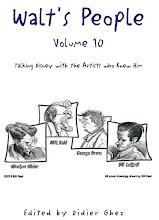
I was working this weekend on an interview with Ub Iwerks conducted by Bob Thomas in the mid-'50s (and which will appear in Walt's People - Volume 10) in which Ub recalls the creation of Mickey Mouse as follows:
"Walt came back discouraged to Hollywood [from his meeting with Mintz in New York] and set-up a meeting with Roy and I to discuss possibilities for a new character. I tried some sketches of dogs and cats, but there were too many cats (like Krazy Kat). Then I went through a batch of magazines. In Life or Judge I ran into cartoons of animals by [Clifton] Meek and got an idea for a mouse. We weren’t artists. There were almost none in the field. We worked out the character: Lilly gave it a name, then we cooked up a story sitting around."
Clifton Meek is pictured above and you can see some of his mice below. Meek also wrote an article about Walt in 1967 titled A Tribute to the Late Walt Disney, which you can read here.
None of this is really new but linked together it just made mee see things a bit more clearly that I had until now and I thought you might enjoy that same "aha"-moment.
Tuesday, July 10, 2007

Alexandar Zograf, whose works I was discussing on this blog yesterday, just forwarded this great piece of information:
[Mickey Mouse in Gurs - humour, irony and criticism in works of art produced in the Gurs internment camp
Author: Pnina Rosenberg
Abstract: Gurs, near the Pyrenees, was the largest camp in the occupied zone of France. In spite of the deplorable conditions in the camp, cultural activities flourished, as in other French internment camps in both zones. In addition to conferences, concerts and plays, this extensive artistic creativity included the works of several artists, who produced drawings and watercolours and mounted exhibitions. The artists, who were political and/or racial refugees, used their works of art, through irony and satire, as a means of protest against the French authorities, who, contrary to hopes and expectations, had turned out to be a collaborator of the Nazi regime. Among the many works of art produced in Gurs those of Horst Rosenthal (Breslau 1915 - Auschwitz 1942?) deserve special attention.
He left behind two graphic novels - Mickey au Camp de Gurs - Publiée sans l'authorisation de Walt Disney (Mickey Mouse in the Gurs Internment Camp - Published without Walt Disney's Permission) and Le Journée d'un hébergé: Camp de Gurs 1942 (A Day in the Life of a Resident: Gurs Internment Camp, 1942) (Centre de Documentation Juive Contemporaine, Paris). Each of these booklets vividly depicts daily life in Gurs. The former is narrated from the point of view of Mickey Mouse, while the latter is written in fairy tale style as a 'book of hours', with an omnipresent author who records and illustrates a day in the life of the young 'resident'. The humorous cartoon-like images, together with the naive, amusing and 'childish' texts, stand in sharp contrast to the harsh reality of the camp, thus enhancing the criticism which lies behind them.
In an ironical twist of history, Rosenthal's Mickey Mouse can be seen as the forerunner of Art Spiegelman's Maus, but, tragically, Rosenthal did not survive to witness his artistic legacy.]
And here is another link about the same subject.
Subscribe to:
Posts (Atom)